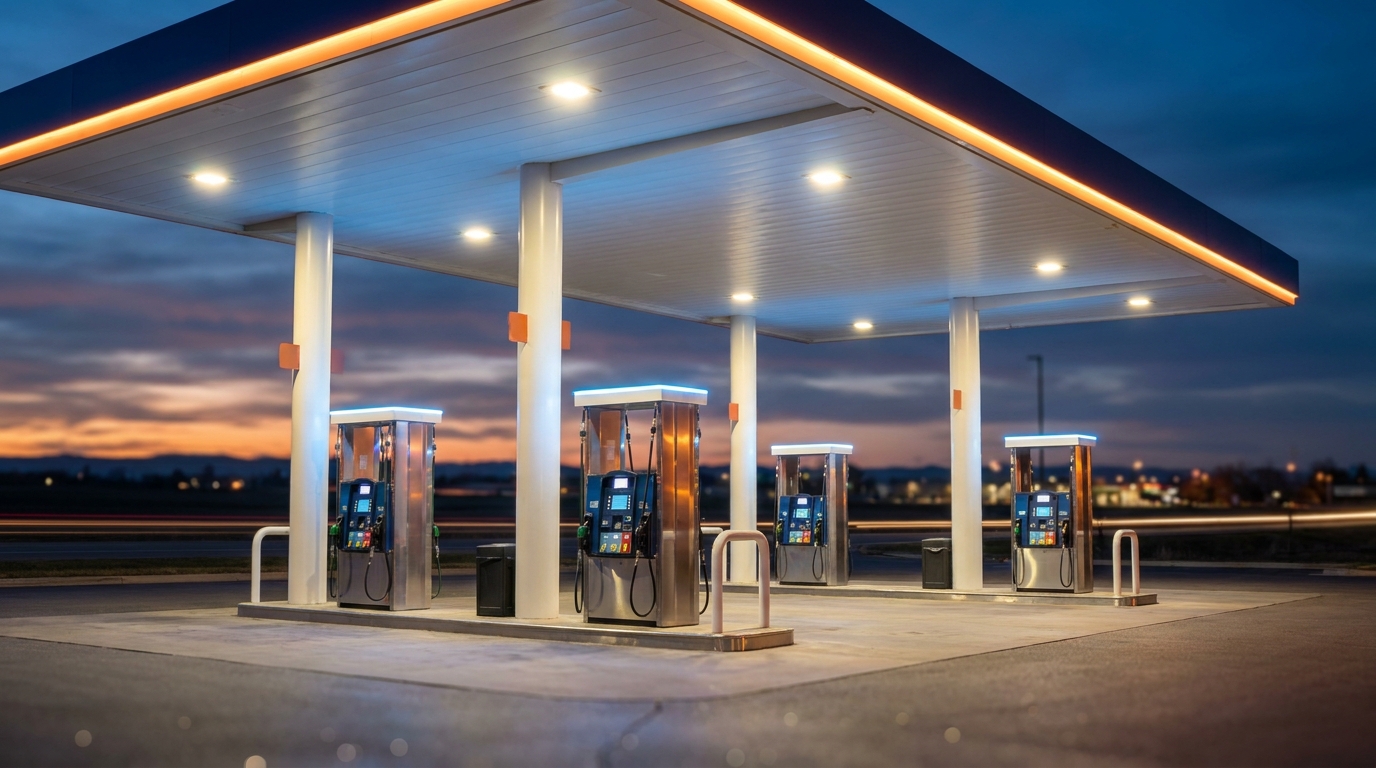
Drivers often assume premium-priced gas station brands deliver meaningfully cleaner fuel, while discount stations sell something inferior. The reality is more nuanced. Every gallon sold in the United States must meet EPA additive standards, and most fuel comes from the same regional terminals. The differences that do exist are real but smaller than marketing suggests. Here is what the evidence shows about Top Tier certification, additive packages, and whether your choice of station matters over the life of an engine.
All US Gasoline Starts From a Common Pool
Roughly 135 petroleum refineries supply the entire US market, and finished gasoline typically reaches retailers through shared pipeline and terminal infrastructure. A tanker truck loading at a terminal in Houston or Linden, New Jersey is generally drawing from the same base stock regardless of which brand sticker ends up on the truck. The difference comes at the rack, where each brand injects its proprietary additive package before delivery.
Since 1995, the EPA has required all gasoline sold in the United States to contain a minimum level of detergent additives intended to control deposits on intake valves and fuel injectors. That floor is the same whether you buy from a major-brand station or an unbranded discount retailer. In that narrow sense, no station sells dirty fuel.
What Top Tier Actually Means
Top Tier is a voluntary standard created in 2004 by a group of automakers including GM, Toyota, Honda, BMW, and Ford. It sets detergent levels well above the EPA minimum and prohibits the use of metallic additives such as manganese-based MMT, which has been linked to deposit and sensor issues. Roughly 70 retail brands in the US currently carry the certification, including Chevron, Shell, Exxon, Mobil, BP, Costco, QuikTrip, and several smaller chains.
Independent testing commissioned by AAA in 2016 reported that non-Top Tier fuels produced noticeably more intake valve and combustion chamber deposits than Top Tier fuels under accelerated lab conditions. The study found deposit levels several times higher with the lower-additive fuels. That said, the test ran on engines deliberately pushed to show differences, and real-world results vary with driving patterns, engine design, and oil maintenance.
Price Spreads Between Brands
EIA weekly retail data consistently shows that branded major-oil stations price 10 to 30 cents per gallon above unbranded discount retailers in the same market. Warehouse clubs like Costco and Sam's Club, which are Top Tier certified, often sit at or below the discount-station price while still meeting the higher additive standard. That combination is hard to beat on a pure dollars-per-clean-gallon basis.
Over 12,000 miles of driving in a vehicle averaging 28 mpg, a 20-cent-per-gallon price gap works out to about 86 dollars per year. Whether that gap is worth paying depends on whether the more expensive station is Top Tier and whether the cheaper one is not.
| Station type | Top Tier certified | Typical price vs market avg | Examples |
|---|---|---|---|
| Major branded | Yes | +5 to +15 cents | Shell, Chevron, Exxon, Mobil, BP |
| Warehouse club | Yes | -10 to -25 cents | Costco, Sam's Club |
| Regional branded | Often yes | -5 to +5 cents | QuikTrip, Wawa, Sheetz, Kwik Trip |
| Grocery / convenience | Mixed | -5 to -15 cents | Kroger, Safeway, 7-Eleven |
| Unbranded discount | Usually no | -10 to -20 cents | Independent stations |
Does It Actually Affect Your Engine
For modern port-injected engines driven on a mix of highway and city trips, deposit buildup from non-Top Tier fuel is usually slow and reversible. A few tanks of higher-detergent fuel, or an occasional bottle of concentrated injector cleaner, can restore most of the lost performance. Owners rarely notice the difference in fuel economy unless deposits become severe.
Direct-injection engines, which now dominate new vehicle sales, are more sensitive. Because fuel does not wash over the intake valves in these designs, additive chemistry matters less for valve cleanliness but more for injector tip deposits and combustion chamber buildup. Manufacturers including GM and BMW have publicly recommended Top Tier fuel for this reason, and some owner's manuals make the recommendation explicit.
Octane, Ethanol, and Storage
Brand matters less than choosing the correct octane for your engine. Using premium in a car designed for regular yields no measurable benefit according to fueleconomy.gov, while using regular in a car that requires premium can reduce power and efficiency. Ethanol content, typically E10 across most of the country, is set by blending rules rather than brand.
Station turnover matters too. A high-volume station, branded or not, sells through its underground tanks quickly, which reduces water accumulation and fuel aging. A rarely visited rural station with old tanks is a bigger risk than any particular brand label.
The takeaway
Buy Top Tier fuel when you can do so without paying a meaningful premium, since warehouse clubs and many regional chains meet the standard at or below market price. For direct-injection engines, the case is stronger. For older port-injected engines, an occasional tank of higher-detergent fuel is usually enough. Octane choice and station turnover matter more than the logo above the pump.