Every 1 PSI your tires are below spec costs roughly 0.2% in fuel economy. That sounds small — until you realize the average American car is driving on tires four to six PSI low, year-round. For a two-car household that's $80 to $150 a year, in exchange for nothing.
Why under-inflated tires waste fuel
A tire is round because it's inflated. When pressure drops, the contact patch — the small area actually touching the road — gets wider and flatter. More rubber on asphalt means more friction, and friction is resistance your engine has to push against every second you're moving.
The US Department of Energy estimates the effect at about 0.2% MPG loss per PSI below the manufacturer's recommended pressure. A tire that's 8 PSI low costs you roughly 1.6% in fuel economy. Over 12,000 miles at $3.75/gallon and 28 MPG, that's about $26 per tire, per year — and you have four of them.
The number on the sidewall is not the number you want
One of the most common mistakes: drivers read the "max pressure" figure embossed on the tire sidewall and inflate to that number. That's the maximum the tire itself can safely hold, not what your car was engineered for.
The correct pressure is on a sticker inside the driver's door jamb — usually 32 to 36 PSI for a sedan, 35 to 42 for a crossover or truck. That number is calibrated to your vehicle's weight, suspension, and tire size. Follow the door jamb, not the sidewall.
Tires lose pressure faster than you'd think
A typical tire loses about 1 PSI per month just from normal air molecule permeation through the rubber. Temperature swings accelerate this: for every 10°F drop, expect another 1 PSI loss. So a tire inflated to 35 PSI in September can easily read 30 PSI by late November with no leak at all.
This is why the TPMS warning light often flickers on during the first cold snap of the year — it's not a malfunction, it's physics. The fix is checking pressure monthly, year-round, and topping up at the start of every season.
How to actually check (the five-minute version)
Check when tires are cold — meaning the car hasn't been driven more than a mile in the last three hours. A hot tire reads 3 to 6 PSI higher than its cold pressure, so checking after a highway drive gives you a false reading.
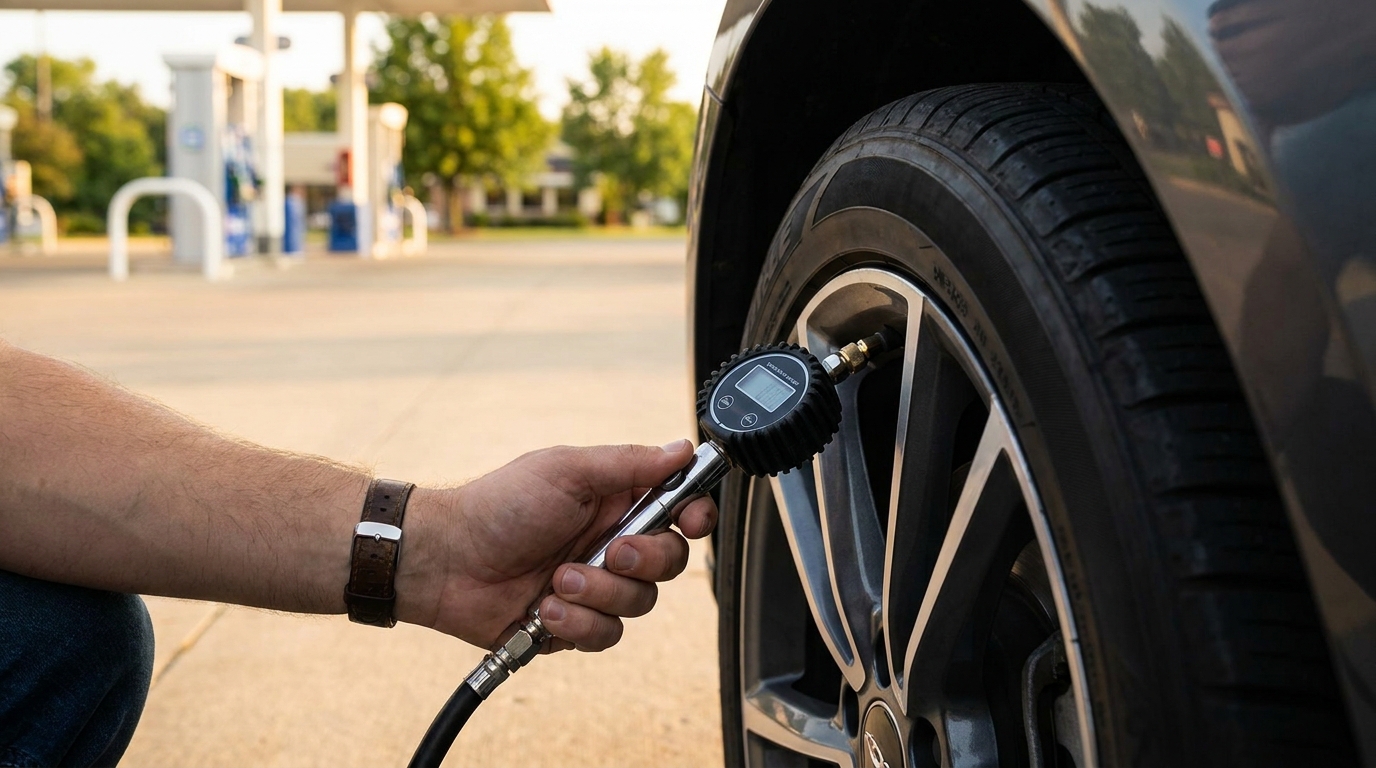
Use a decent digital gauge, not the one built into the gas-station air pump. Those are notoriously inaccurate. A $10 digital pencil gauge is a one-time purchase that will outlive the car.
Set all four to the door-jamb number and check the spare once a quarter — a flat spare is useless when you need it.
Nitrogen, green valve caps, and other marketing
You'll see tire shops upsell nitrogen fills for $5 to $10 a tire. The pitch: nitrogen molecules are larger than oxygen, so pressure stays stable longer. Technically true, but the difference over a month is about 0.5 PSI — inside the margin of error of most gauges.
Regular air is already 78% nitrogen. For $40 a year you can do just as well by checking pressure yourself. Save the upsell for airplane tires and race cars.
The takeaway
The math isn't complicated: five minutes a month, a $10 gauge, and the number from your door jamb. That's the entire upgrade. Skip it and you're donating about $100 a year to inefficient combustion.