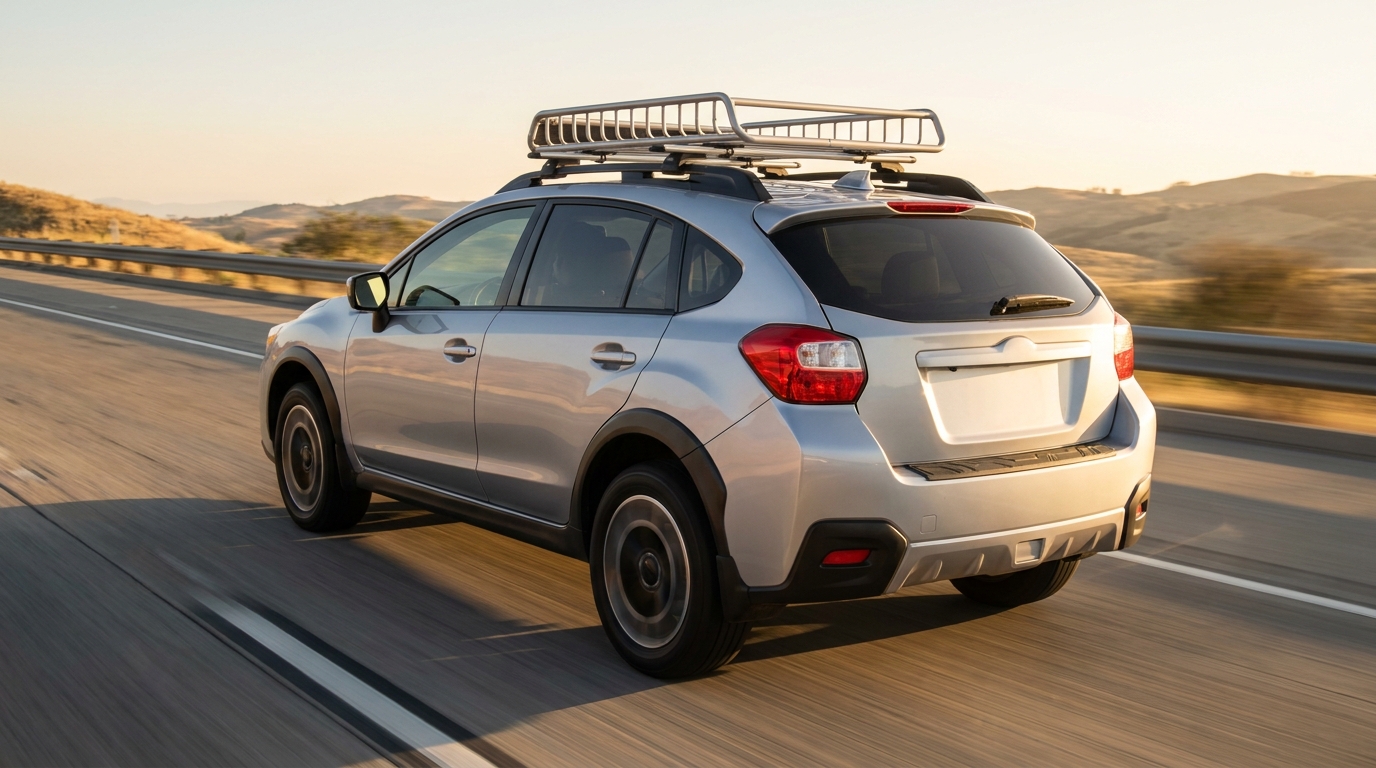
Roof racks and cargo boxes are convenient, but they are not free. Every crossbar, basket, and clamshell box adds frontal area and turbulence, and the drag penalty scales with the square of speed. The US Department of Energy has studied this repeatedly, and the numbers are larger than most drivers assume. Here is what a rack actually costs at the pump, and when it makes sense to take it off.
Why drag matters more at highway speed
At city speeds, rolling resistance and engine losses dominate fuel use. Once you pass roughly 45 mph, aerodynamic drag becomes the single largest force the engine has to overcome. Because drag rises with the square of speed, doubling your pace roughly quadruples the aerodynamic load. That is why a rack that seems harmless around town becomes a meaningful tax on a long interstate drive.
The US Department of Energy and fueleconomy.gov both note that aerodynamic losses can account for more than half of the energy a vehicle uses at 70 mph. Anything that disturbs airflow over the roofline, where the car has already worked hard to keep the air attached, tends to show up quickly on the trip computer.
What the studies actually found
A widely cited 2016 study by researchers at Lawrence Berkeley National Laboratory estimated that roof racks and cargo boxes were responsible for roughly 0.8 percent of US light-duty fuel consumption, or about 100 million gallons of gasoline per year. The study modeled both loaded and empty configurations across the vehicle fleet.
On an individual vehicle, the Department of Energy reports that a large, loaded roof-top cargo box can reduce fuel economy by 6 to 17 percent at highway speeds on a conventional SUV, and by an even larger percentage on a small, efficient car. Rear-mounted cargo boxes, which sit in cleaner air behind the vehicle, typically cost only 1 to 2 percent. Empty crossbars alone usually fall somewhere between these two, depending on shape and mounting height.
Translating percentages into dollars
The percentages sound abstract until you attach them to a real trip. Consider a midsize SUV that normally returns 28 mpg on the highway. A loaded cargo box that cuts efficiency by 15 percent drops that number to roughly 24 mpg. Over a 500-mile weekend drive, that is about three extra gallons of fuel.
At recent national average gasoline prices tracked by the EIA, three gallons is somewhere in the four to twelve dollar range depending on the region and the week. Not catastrophic for one trip, but a driver who leaves the box on year-round can easily spend one hundred to three hundred extra dollars annually, without ever using the cargo space.
Not all racks are equal
Shape matters. Modern aero-profile crossbars, which use a teardrop cross section, produce measurably less drag than the older square steel bars still common on rental fleets and older vehicles. Manufacturer wind-tunnel data typically shows aero bars cutting drag contribution by roughly a third compared with square bars, though independent verification is limited.
Mounting height matters too. Racks that sit flush with factory rails disturb less air than tall towers clamped to a bare roof. And a streamlined cargo box, while worse than bare bars, is far better than an open basket piled with luggage, bicycles, or a kayak strapped flat against the wind.
When to leave it on, when to take it off
For drivers who use their rack most weekends, the labor of removing and reinstalling it usually is not worth the modest savings, especially with aero bars. For drivers who use it a few times a year, the math flips quickly. Removing an unused cargo box before a long highway commute pays for itself within a tank or two.
If removal is not practical, at least take the box off and leave only the bars. And if you are shopping for a rack, prioritize low-profile aero crossbars and a streamlined box over a cheap basket. The upfront cost difference is often recovered in fuel within a couple of seasons of regular highway use.
The takeaway
A roof rack is a tool, not a permanent fixture. Empty aero bars cost little, but a loaded cargo box can trim highway fuel economy by 10 percent or more, adding up to real money over a year. If you are not using it this week, take the box off and leave the bars. If you rarely use the rack at all, remove the whole system between trips.