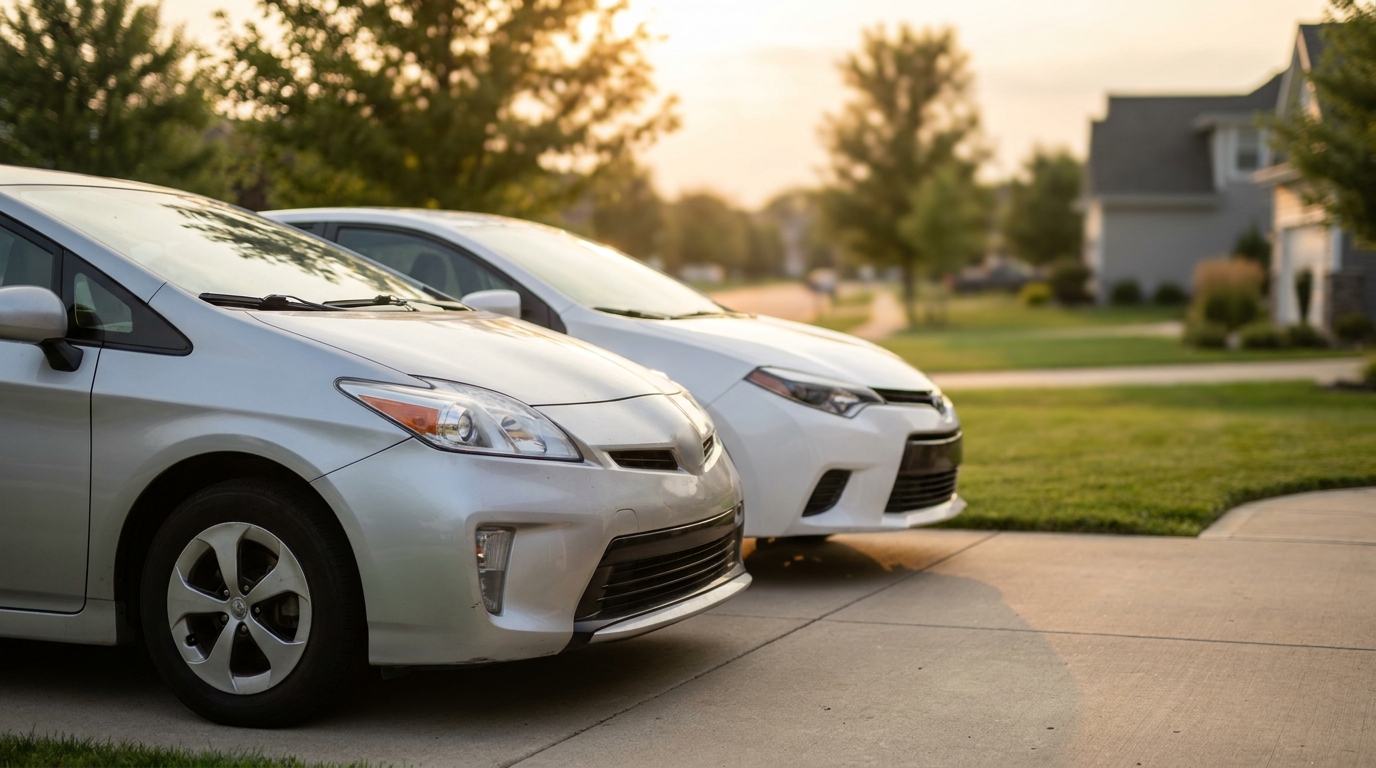
Buying a three-year-old hybrid instead of a new gas car sounds thrifty on paper, but the math is not always obvious. Depreciation, financing rates, insurance, maintenance, and fuel all move in different directions. Using EPA fuel economy data, EIA gasoline prices, and typical dealer transaction figures, we walked through a five-year ownership window for both paths to see which one actually leaves more money in your account.
Setting Up a Fair Comparison
To keep the exercise honest, we picked two vehicles a real shopper might cross-shop: a three-year-old midsize hybrid sedan with roughly 40,000 miles, and a new compact gas sedan of similar interior space. As of late 2024, the used hybrid transacts around 22,000 dollars while the new gas car lands near 25,000 dollars after typical incentives, based on industry pricing trackers.
We assumed 12,000 miles a year, a five-year hold, and financing 80 percent of the purchase price. Used auto loan rates run about two percentage points higher than new-car rates, according to Federal Reserve consumer credit data. Gasoline is priced at the recent EIA national average, and we used EPA combined mpg figures from fueleconomy.gov for both vehicles.
Depreciation Does the Heavy Lifting
The single largest cost of new-car ownership is depreciation, and it front-loads hard. Industry data consistently shows a new vehicle losing 20 to 30 percent of its value in year one, and roughly 50 to 60 percent by year five. A 25,000 dollar new gas car is realistically worth 10,000 to 12,000 dollars when you sell it.
The used hybrid has already absorbed the steepest part of that curve. Over the next five years it will still depreciate, but at a shallower rate, likely retaining 45 to 55 percent of its purchase price. Hybrids from established brands have shown particularly firm residuals in recent years as fuel prices stayed elevated and used inventory tightened.
Fuel and Maintenance Over Five Years
This is where the hybrid claws back money. At an EPA combined rating near 50 mpg versus about 35 mpg for the new compact gas car, and at roughly 3.30 dollars per gallon, the hybrid burns about 800 gallons over 60,000 miles while the gas car burns closer to 1,700. That is a fuel-cost gap of roughly 2,900 dollars across the hold period.
Maintenance is closer than people assume. Hybrids benefit from regenerative braking, which extends brake life significantly, and modern hybrid battery failures out to eight or ten years are uncommon on mainstream models. The used car will need tires, fluids, and possibly a 12-volt battery sooner, which we budgeted at about 600 dollars more than the new car over five years.
The Full Five-Year Ledger
When you stack depreciation, interest, insurance, fuel, and maintenance, the used hybrid comes out ahead by a meaningful margin in our base case. The new gas car wins on interest rate and on the first year of maintenance, but loses badly on depreciation and fuel.
The table below shows the totals. These are estimates, not guarantees, and your local gas prices, insurance quotes, and driving mix will shift the numbers. Still, the direction of the result holds up across a wide range of reasonable assumptions.
| Cost category | Used hybrid (3-yr-old) | New gas compact |
|---|---|---|
| Purchase price | $22,000 | $25,000 |
| Depreciation over 5 yrs | $10,500 | $14,000 |
| Interest paid (financed 80%) | $3,900 | $2,600 |
| Fuel (60,000 mi) | $2,650 | $5,570 |
| Insurance (5 yrs) | $7,200 | $7,800 |
| Maintenance & tires | $3,400 | $2,800 |
| Total 5-yr cost | $27,650 | $32,770 |
When the New Gas Car Actually Wins
There are scenarios where buying new pencils out better. If you drive under 8,000 miles a year, the fuel savings shrink and the depreciation gap matters more. If you plan to keep the car ten or more years, the new-car penalty amortizes over a longer period and the reliability of a fresh warranty has real value.
Manufacturer incentives also matter. When automakers offer subvented financing at 1.9 or 2.9 percent on new gas models, the interest gap can swing 1,500 to 2,000 dollars in favor of new. And if the used hybrid you are eyeing is out of its battery warranty and lacks service records, the risk premium may not be worth the fuel savings.
The takeaway
For a typical driver logging 12,000 miles a year, a well-chosen three-year-old hybrid tends to beat a comparable new gas car by roughly 4,000 to 6,000 dollars over five years, mostly through avoided depreciation and lower fuel spend. Verify service records, check the hybrid battery warranty terms, and run the numbers with your actual insurance quote and local gas price before signing.