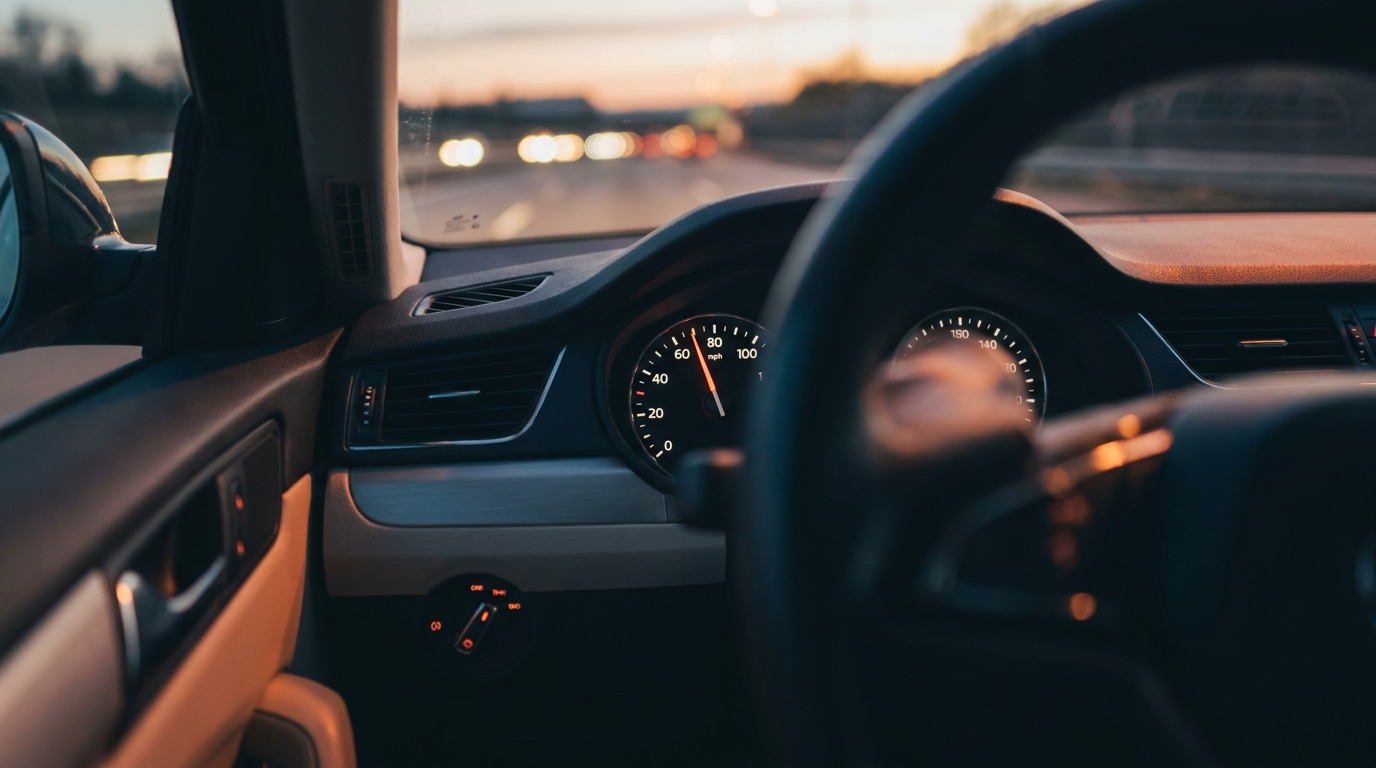
Most drivers know that flooring it burns fuel. Fewer realize how sharply steady-state cruising economy degrades once you pass a fairly modest threshold. The US Department of Energy and EPA have published road-load and dynamometer data for decades, and the pattern is remarkably consistent across vehicle classes. Above roughly 50 mph, aerodynamic drag begins to dominate, and every additional 5 mph carries a measurable fuel penalty that shows up directly at the pump.
Why fuel economy peaks in the 45 to 55 mph band
A vehicle at cruise is fighting three main forces: rolling resistance from the tires, driveline and accessory losses, and aerodynamic drag. Rolling resistance rises roughly linearly with speed, while aerodynamic drag rises with the square of speed. The power needed to overcome that drag therefore rises with the cube of speed, which is the physics behind the classic MPG curve.
Combine that with the engine's own efficiency map, and most modern gasoline cars land their best steady-state economy somewhere between 45 and 55 mph. Below that band, engines run at part-load in less efficient regions of the map. Above it, drag climbs faster than the powertrain can compensate, and MPG drops off quickly.
What the EPA and DOE numbers actually show
The Department of Energy, through fueleconomy.gov, publishes an often-cited chart based on testing of multiple vehicles. It shows fuel economy peaking near 50 mph and declining steadily through 60, 70, and 80 mph. Average penalties land in a familiar range: roughly 7 to 14 percent worse at 60 mph versus 50, another 10 to 15 percent worse at 70, and another 15 to 20 percent worse again at 80.
Individual vehicles vary. A slippery sedan with a tall top gear may only lose 10 percent going from 65 to 75 mph. A tall, boxy pickup or SUV can lose 20 percent or more over the same jump, because its frontal area and drag coefficient conspire against it. But the shape of the curve is nearly universal.
Translating the curve into dollars
Consider a driver averaging 32 mpg at 60 mph in a midsize sedan. Push the cruise to 75 mph and real-world economy commonly falls to about 26 mpg, a 19 percent hit. On a 400-mile trip, that is roughly 3 extra gallons burned. At an EIA national average of around 3.10 dollars per gallon for regular, that is close to 10 dollars added to a single interstate run.
Scale that across a year of regular highway driving and the numbers stop being trivial. A commuter putting 15,000 highway miles on the odometer can easily spend 300 to 500 dollars more per year simply by cruising at 78 instead of 65. No hardware change, no fuel additive, no driving app can match that savings.
Where the penalty is largest
The steepest losses happen where drag is highest. Full-size pickups, body-on-frame SUVs, and vehicles with roof racks, rooftop cargo boxes, or bed-mounted accessories fall off the curve faster than sedans and crossovers. EPA testing has documented rooftop cargo boxes cutting highway fuel economy by 10 to 25 percent on their own.
Towing amplifies the effect further. A trailer roughly doubles the effective drag profile of the tow vehicle, which is why manufacturers frequently recommend keeping tow speeds below 65 mph. The recommendation is partly about drivetrain heat, but the fuel math points the same direction.
Practical takeaways for daily driving
You do not need to crawl in the right lane to see meaningful savings. Dropping cruising speed from 78 to 70 mph is usually enough to recover most of the lost economy without materially changing your arrival time on typical trips. On a 60-mile commute, the time difference is roughly 5 minutes.
Cruise control helps by holding a steady speed and preventing the slow drift upward that most drivers do not notice. Keeping tires at the door-placard pressure, removing unused roof accessories, and avoiding hard acceleration back to speed after slowdowns all compound with a lower cruise speed.
The takeaway
The single most reliable fuel-saving move available to any driver is slowing down on the highway. Cutting steady-state cruise from the high 70s into the mid 60s typically recovers 15 to 20 percent of highway fuel economy, at essentially no cost and minimal time penalty on normal trips. No aftermarket gadget or driving hack comes close to that return.