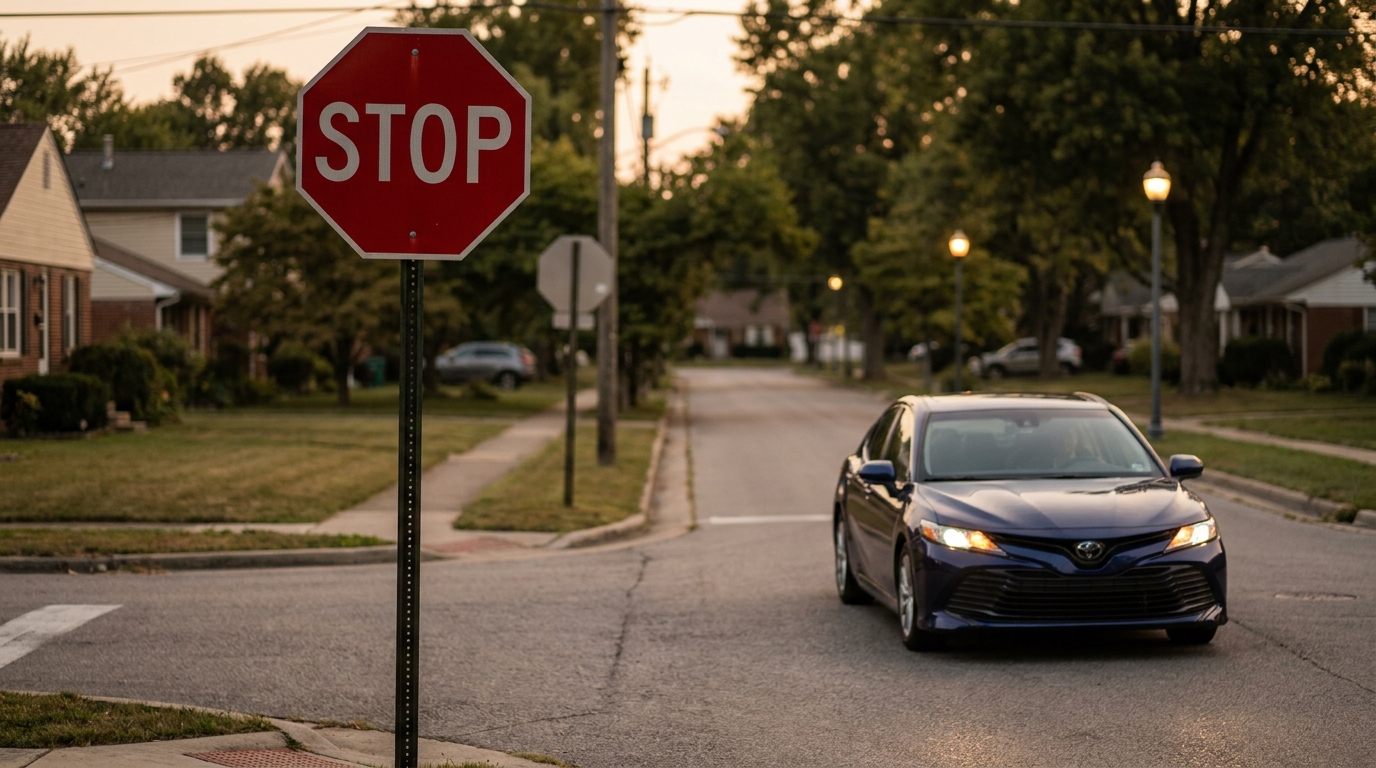
The rolling stop, or California stop, is one of the most common traffic violations in the United States. Drivers often justify it on efficiency grounds, arguing that a full stop wastes fuel by killing momentum. There is a kernel of physics behind that claim, but the actual savings are smaller than most people assume. We ran the numbers using published vehicle energy data to see what a rolling stop is really worth.
The Physics of Stopping and Starting
Every time a vehicle decelerates to zero and accelerates back to cruising speed, it loses kinetic energy as heat in the brakes and then spends fuel rebuilding that energy at the wheels. Kinetic energy scales with the square of speed, so a 3,500 pound sedan going from 25 mph to zero dumps roughly 73,000 joules of energy into the brake rotors. Recovering that speed from a dead stop requires the engine to produce that same energy, plus overhead for driveline losses and idle fuel burn during the launch.
A rolling stop preserves some fraction of that kinetic energy. If a driver slows from 25 mph to 5 mph instead of zero, they retain about 4 percent of the original kinetic energy, since energy scales with velocity squared. That sounds trivial, and in isolation it is. The savings only matter when multiplied across thousands of intersections per year.
What the Fuel Math Actually Shows
The US Department of Energy estimates that aggressive stop-and-go driving can reduce fuel economy by 15 to 30 percent in city traffic compared to smooth driving. That figure covers the full range of hard braking and hard acceleration, not the marginal difference between a full stop and a rolling stop at a low-traffic sign.
For a typical gasoline sedan getting 30 mpg in the city, a single full stop and restart from 25 mph consumes roughly 0.005 to 0.008 gallons of fuel more than a rolling stop through the same intersection. At $3.20 per gallon, that is about 1.5 to 2.5 cents per event. A driver who encounters 10 stop signs per day and rolls all of them would save between $55 and $90 per year. Real-world numbers land at the low end, because most drivers already coast toward stop signs rather than braking hard from cruising speed.
Where the Bigger Savings Actually Live
The EPA and fueleconomy.gov consistently point to three habits that dwarf rolling stops in impact. Smooth acceleration from a stop, sometimes called the driven-with-care technique, can improve city fuel economy by 10 to 20 percent on its own. Reducing highway cruising speed from 75 to 65 mph typically saves 10 to 15 percent. Removing 100 pounds of unnecessary cargo saves about 1 percent.
Compared to those levers, the rolling stop is noise. A driver focused on efficiency would get far more mileage, literally, from easing off the throttle earlier before intersections and accelerating gently afterward. Both techniques are legal, safer, and require no confrontation with local law enforcement.
The Cost Side of the Ledger
Rolling stop citations in most US states carry fines between $150 and $250, plus court fees and, in many jurisdictions, one or two points on the driver's license. Insurance surcharges for a single moving violation typically raise premiums by 10 to 25 percent for three years. A driver in a state with average premiums around $1,800 per year could see cumulative added cost above $1,000 from one ticket.
That is more than a decade of maximum theoretical fuel savings from rolling every stop sign on the daily commute. And the calculation ignores the collision risk. Rolling stops are a documented contributing factor in a meaningful share of intersection crashes involving pedestrians and cyclists, according to NHTSA crash data summaries.
Hybrids and EVs Change the Calculation Further
Modern hybrids and all electric vehicles use regenerative braking to recover a portion of the kinetic energy that would otherwise be lost. Manufacturers cite recovery efficiencies in the range of 60 to 70 percent under typical deceleration. For these vehicles, the fuel or energy penalty of a full stop is roughly a third of what it is for a conventional gasoline car.
In practical terms, a Toyota Prius or a Tesla Model 3 driver saves almost nothing by rolling stop signs. The onboard systems already handle most of the energy recovery that a rolling stop would preserve mechanically. The habit is a holdover from an earlier era of drivetrains.
The takeaway
Rolling stops save real energy, but the amount is trivial compared to smoother acceleration, lower highway speeds, or removing weight. One citation erases a decade of theoretical savings, and hybrids and EVs already recover most of the energy anyway. Come to a full stop, then accelerate gently. That combination beats the California stop on fuel, safety, and cost.