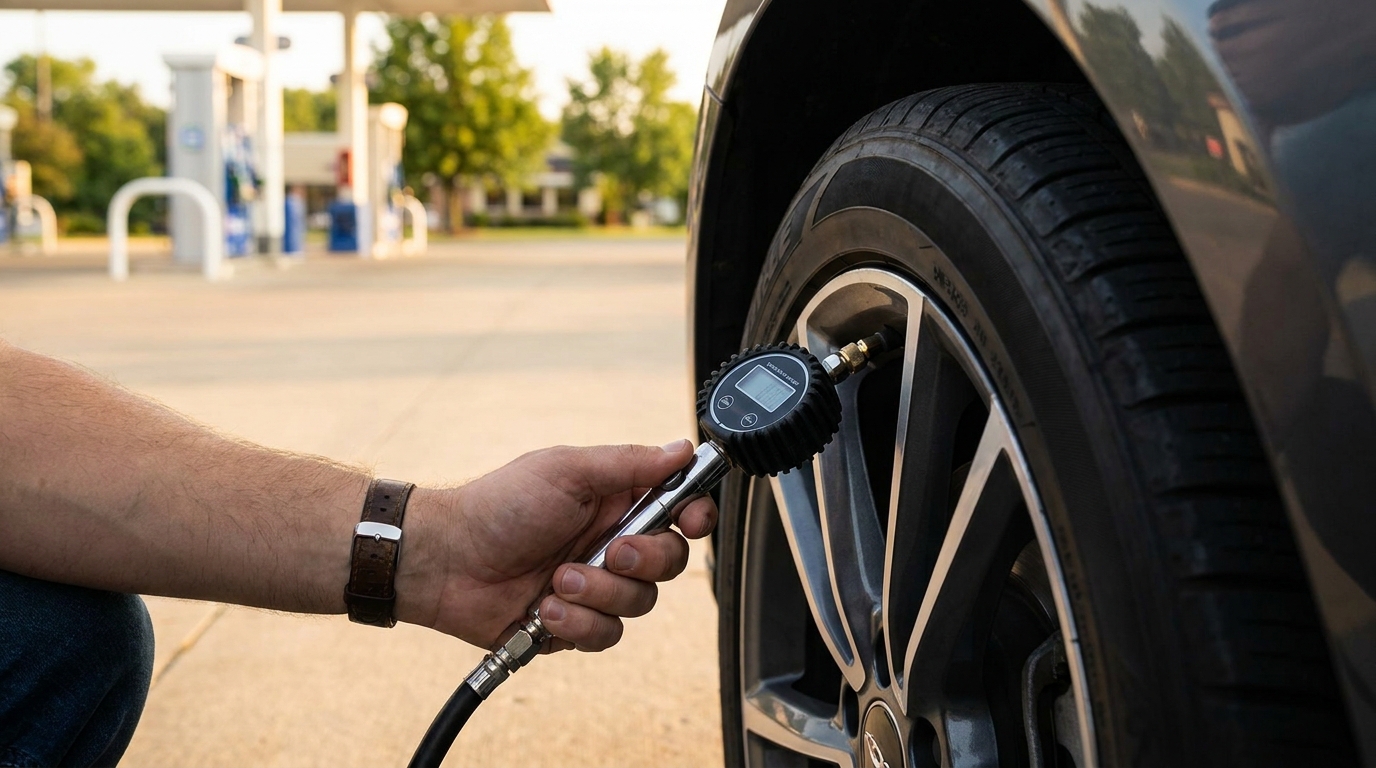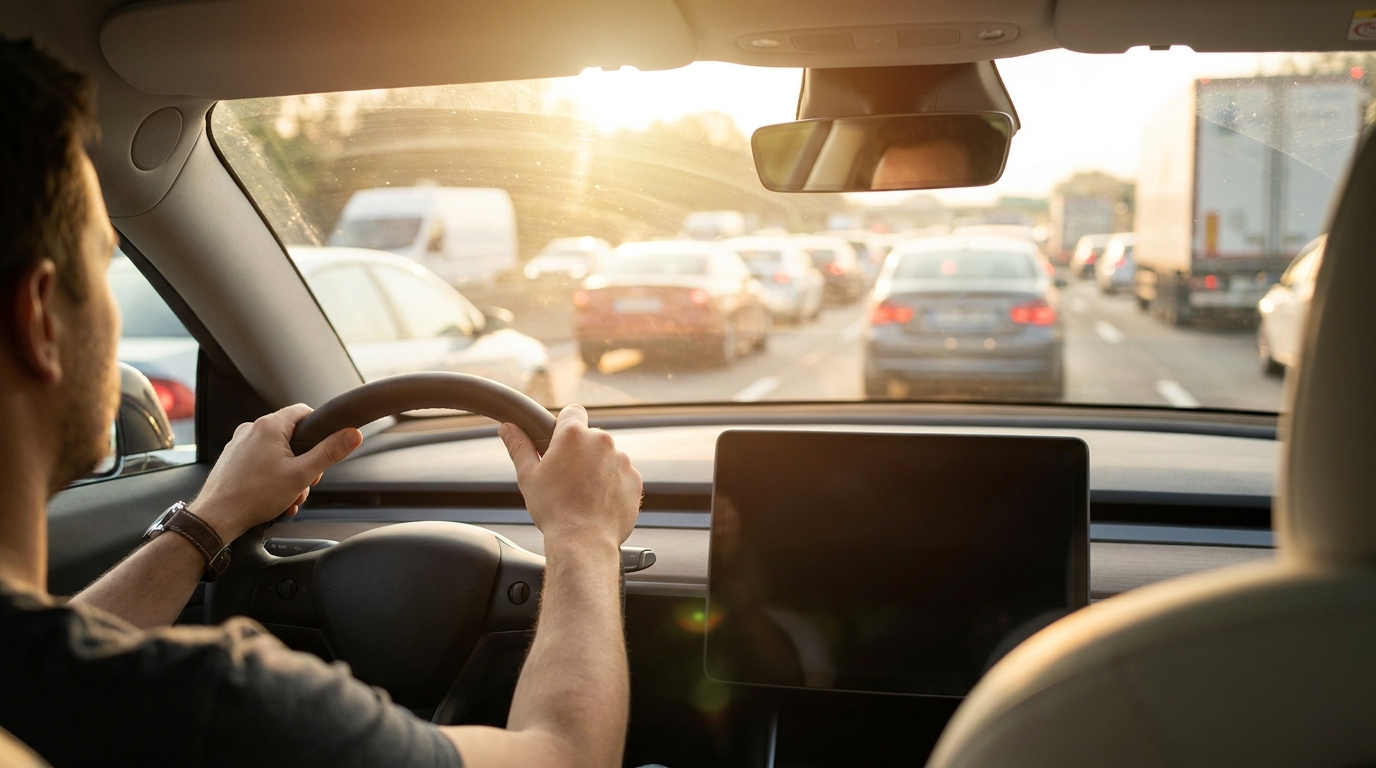
The US Department of Energy has a neat, unambiguous number on this: aggressive driving costs 15 to 30% of your highway fuel economy and up to 40% in city traffic. That's the single biggest lever most drivers have — bigger than tire pressure, bigger than maintenance, bigger than your choice of gas station.
What "aggressive" actually means
Aggressive driving isn't just street racing. In fuel-economy terms it's three specific behaviors: accelerating hard from stops, braking late and hard, and maintaining speeds more than about 5 mph above the flow of traffic.
The common thread is energy waste. Every time you accelerate hard, you dump fuel into the engine to build kinetic energy. Every time you brake hard, you throw that same kinetic energy away as heat in your brake pads. Smooth driving keeps more of that energy in the car.
Why stop-and-go traffic punishes aggressive drivers the most
On a flat highway at a steady 60 mph, aggressive driving is mostly wasted on the passing maneuvers — maybe 10 to 15% of your fuel. In city traffic, every light cycle is a chance to dump energy. This is why EPA city ratings drop 30 to 40% when aggressive-driving behavior is modeled into the test.
Hybrids punish aggressive driving differently but just as hard: a Prius or a RAV4 Hybrid relies on regenerative braking to feed the battery, and hard braking activates the friction brakes instead, bypassing the regen entirely. An aggressive driver in a Prius can see real-world MPG 20% below the window sticker.
The "one car length" rule
A practical technique: leave one car length of following distance per 10 mph of speed. At 60 mph, that's six car lengths. It feels like a lot in traffic — until you realize it lets you slow down by lifting off the throttle instead of braking, every single time.
Drivers who follow this rule commonly report real-world MPG 2 to 4 points higher than the EPA combined rating, without consciously "trying to save gas" — the habit just removes most of the hard-braking events.
Cruise control is cheating, and that's fine
On flat highways, cruise control beats the average driver's throttle foot every time. It holds a perfectly constant speed, which is fundamentally more efficient than the micro-accelerations a human makes unconsciously.
The exception is hilly terrain. Older cruise-control systems downshift aggressively to hold speed on climbs, which wastes fuel. Modern adaptive cruise is smarter — but if you drive a 10-year-old car in mountains, manual throttle on the hills is usually the better call.
How much is this actually worth to you?
Take the low end of the DOE estimate — 15% — on a car getting 28 MPG combined, 12,000 miles a year, at $3.75/gallon. That's about $240 a year in fuel you're burning to accelerate harder than you need to.
Take the high end of the city figure — 40% — on a rideshare or delivery driver doing 25,000 miles a year in urban traffic, and the same math puts the penalty at over $1,200. This is why ride-hailing drivers who switch to "grandma mode" report some of the largest fuel-savings gains in the consumer literature.
The takeaway
You don't have to drive slowly to drive efficiently. You have to drive smoothly. Look three cars ahead instead of one, leave more gap, and let the throttle and engine do the decelerating whenever you can see it coming. The fuel bill will tell you if it's working.