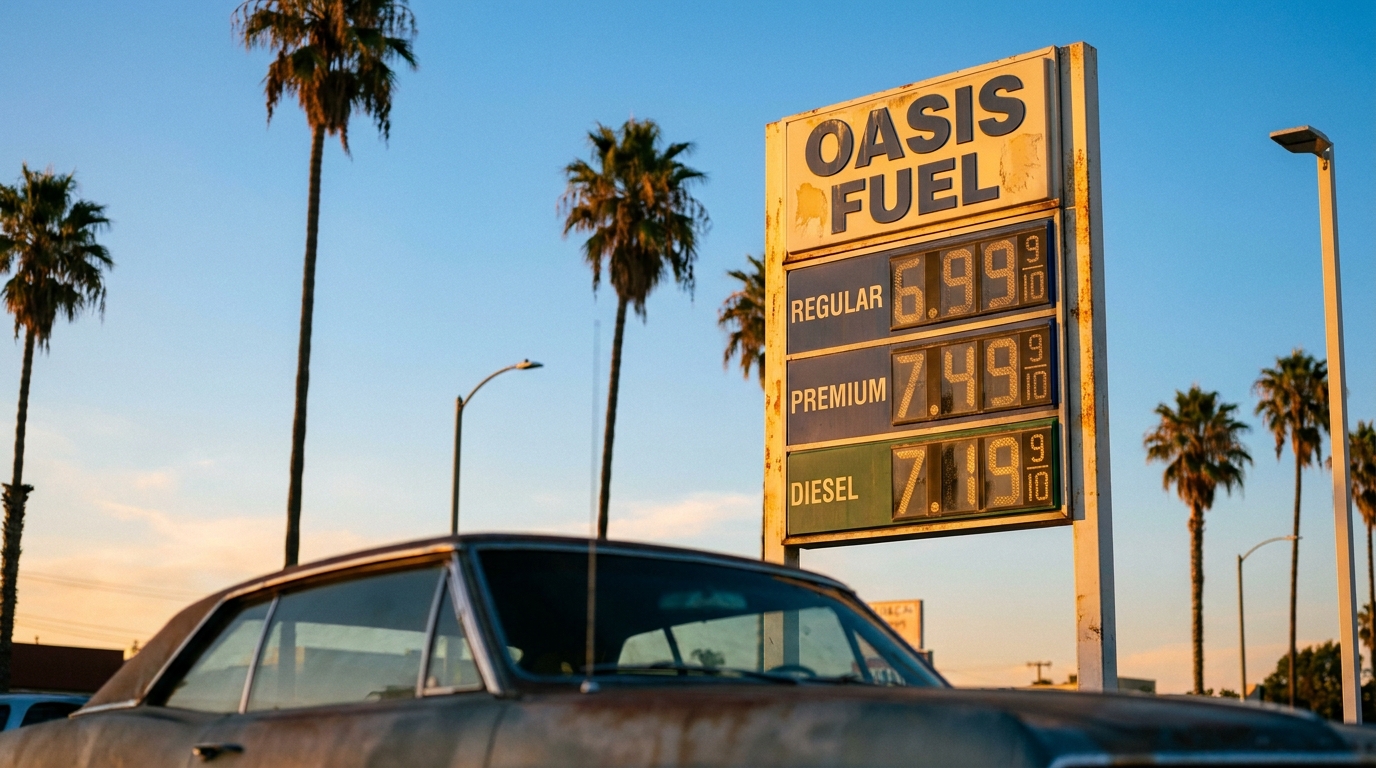
California has the highest retail gas prices in the continental US, year after year. In 2026 the average California driver pays about $1.50 to $2.00 more per gallon than a driver in Texas or Louisiana. There's no single culprit — four distinct structural factors stack, and none of them are changing soon.
1. Taxes: the biggest slice
California's combined state gasoline taxes and environmental fees are the highest in the country — about $0.68 per gallon in 2026, compared to a national state-tax average of $0.32 and a low of $0.09 in Alaska.
That figure includes the state excise tax, sales tax applied to fuel, the Low Carbon Fuel Standard surcharge, and the Cap-and-Trade program cost pass-through. About $0.40 of the California-vs-average gap is tax alone, and state legislation indexes most of these to inflation — so the gap grows, not shrinks, over time.
2. CARB gasoline: a blend only California uses
California requires a specific reformulated gasoline blend designed by the California Air Resources Board (CARB) to reduce summer smog. It has a lower Reid Vapor Pressure, different oxygenate chemistry, and tighter sulfur limits than federal EPA-RFG gasoline.
Only about ten refineries in the world are tooled to produce CARB gasoline, and all of them are in California, Washington, or rebated to work around it. This makes California's gasoline supply effectively an island — a single refinery outage can't be papered over by imports from neighboring states, because neighboring states don't make the right fuel.
3. Refinery concentration and outage risk
California has 17 operating refineries, down from 30 in 1985. Three of those — Chevron Richmond, Marathon Los Angeles, and PBF Energy Martinez — produce more than half of the state's gasoline. When one of them goes down for unplanned maintenance, the state's wholesale price spikes within days because the CARB-blend supply chain has no slack.
Hurricane Katrina taught Gulf states to hold more refinery redundancy. California refinery closures have done the opposite: capacity has concentrated, and the state has fewer options when something breaks.
4. Distribution: far from everything
Most US gasoline moves through a pipeline network radiating from the Gulf Coast. California is not on that network — it's served almost entirely by in-state refineries and marine tanker shipments from Washington, Alaska, and Asia. When CARB supply runs tight, imports of qualifying blend can take two to four weeks to arrive by tanker.
The cost of this logistics isolation shows up as wider-than-normal wholesale-to-retail spreads. In most states the spread is about $0.50 per gallon. In California, $0.70 to $1.00 is typical.
Why nothing fixes it quickly
Each of these factors has constituencies defending it. Environmental groups support CARB gasoline and the LCFS because they genuinely do reduce smog and carbon emissions. Labor and environmental-justice coalitions have opposed new refinery permits. Tax revenue funds transportation infrastructure.
Any one of these could be undone by legislation, but all four would have to change for California's prices to converge with national averages — and the political coalition to do all four doesn't exist in Sacramento or Washington. Expect the gap to persist for at least another decade.
The takeaway
California's gas-price gap isn't a fluke or a conspiracy — it's the predictable result of the state's tax, environmental, refining, and logistics choices, stacked. If you live there, the arithmetic of car ownership is simply different. If you're driving through, fill up before you cross the border.