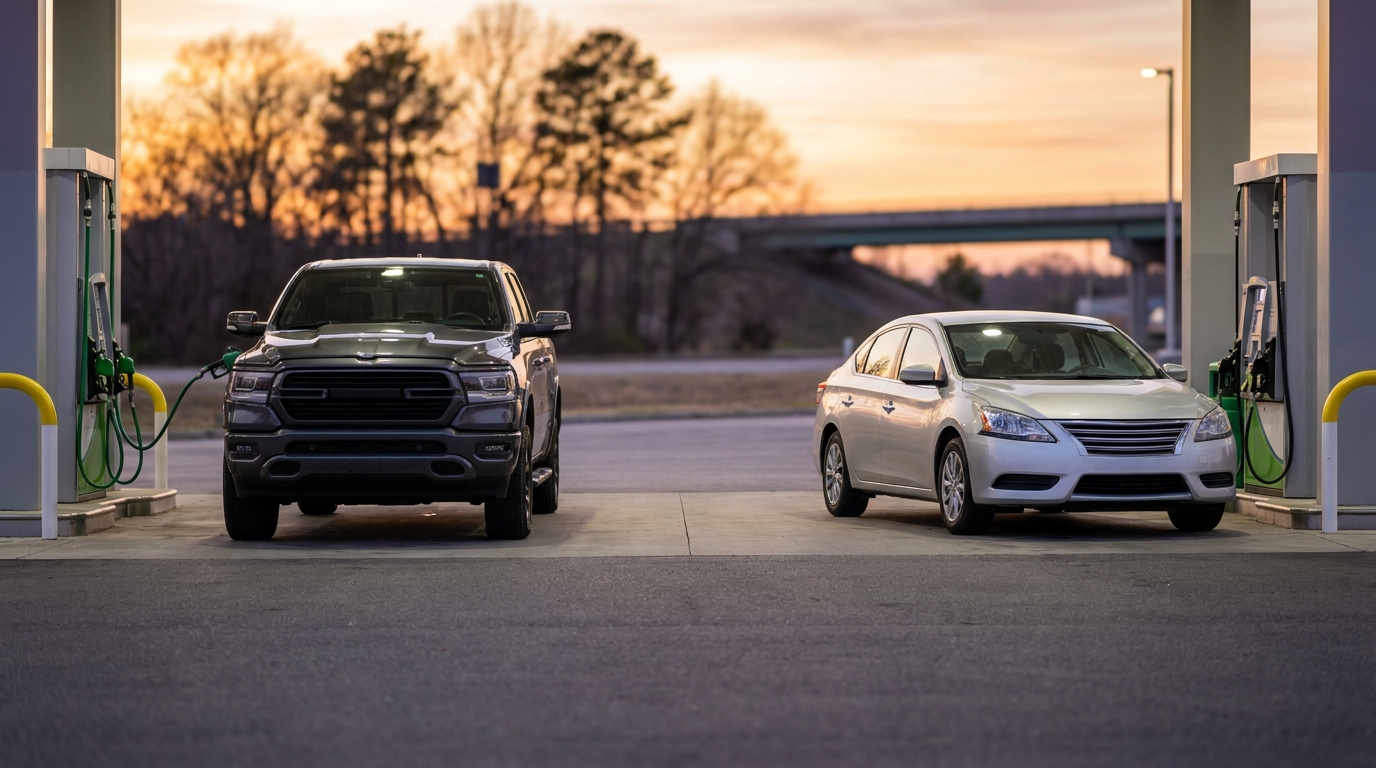
The diesel versus gasoline debate keeps surfacing because the answer keeps shifting. Fuel prices, emissions rules, and powertrain technology have all moved in the past five years, and what was true in 2018 is not necessarily true heading into 2026. We pulled together pump prices, EPA mileage data, maintenance intervals, and resale trends to see where each fuel type actually pays off for a typical American driver today.
What the pump tells you in 2026
Diesel has traded at a premium to regular gasoline for most of the past three years. According to EIA weekly retail data, the national average for on-highway diesel has run roughly 15 to 25 percent above regular unleaded since 2022, driven by tight refining capacity for distillates and steady demand from freight. That premium has narrowed at times but rarely reversed.
For drivers, the pump price is only half the picture. Diesel engines convert more of each gallon into useful work, so a modern light-duty diesel typically returns 20 to 30 percent better fuel economy than a comparable gasoline version, especially on the highway. The math gets interesting only when you combine both numbers, and it does not always favor diesel.
Cost per mile, honestly calculated
Take a midsize pickup as an example. A gasoline V6 rated at 22 mpg combined burning fuel at $3.20 a gallon costs about $0.145 per mile. A comparable diesel rated at 27 mpg combined burning fuel at $3.85 a gallon comes in around $0.143 per mile. Functionally identical.
The diesel pulls ahead on long highway runs, where its mpg advantage stretches to 30 percent or more, and falls behind in stop-and-go city driving where regen cycles and idle hurt efficiency. If most of your miles happen in suburbs and short trips, the fuel savings rarely offset the higher purchase price, which often runs $3,000 to $9,000 more for the diesel option.
| Vehicle type | Gas mpg | Diesel mpg | Gas $/mi | Diesel $/mi |
|---|---|---|---|---|
| Midsize pickup | 22 | 27 | $0.145 | $0.143 |
| Half-ton pickup | 20 | 26 | $0.160 | $0.148 |
| Full-size SUV | 18 | 23 | $0.178 | $0.167 |
| Compact SUV | 28 | 35 | $0.114 | $0.110 |
Maintenance: the line item people underestimate
Modern diesels are robust, but they are not cheap to service. Diesel exhaust fluid runs around $3 to $4 a gallon and most light-duty trucks consume it at roughly two to three percent of fuel volume. Fuel filters are more expensive and more frequent. Diesel particulate filter regeneration is automatic but adds wear, and a clogged DPF replacement can run well past $3,000 out of warranty.
Gasoline engines, especially modern direct-injection units, are not maintenance-free either. Carbon buildup on intake valves is a known issue on some designs, and timing chain repairs are not trivial. Still, on a ten-year ownership horizon, fueleconomy.gov maintenance estimates and independent surveys generally show gasoline vehicles costing 15 to 25 percent less to keep on the road.
Longevity and resale
The folklore that diesels last forever has truth to it for heavy-duty applications. Commercial diesel engines routinely cross 300,000 miles, and well-maintained light-duty diesels often clear 250,000. Gasoline engines have closed that gap considerably. A modern naturally aspirated V6 or four-cylinder regularly reaches 200,000 miles with basic care.
Resale tells a similar story. Diesel pickups hold value strongly in regions with active farming, towing, and trades work. Outside those markets, the resale premium has been softening as buyers weigh higher repair risk and uncertainty around future emissions regulations. Gasoline trucks and SUVs have seen steadier, more predictable depreciation curves.
Who should still buy diesel
Diesel still makes clear sense for three groups. Drivers who tow heavy loads regularly benefit from the torque and thermal efficiency under load. Drivers who log 25,000 miles or more annually, mostly on highways, recover the price premium through fuel savings within a reasonable window. And operators in rural areas where diesel is cheaper relative to gasoline than the national average can tip the math further.
For everyone else, including the suburban commuter, the weekend hauler, and the family that takes one road trip a year, a modern gasoline powertrain is usually the more rational financial choice. Hybrids complicate this comparison further, and we treat that matchup separately.
The takeaway
For most American drivers in 2026, a modern gasoline vehicle is the cheaper and simpler choice over a ten-year horizon. Diesel earns its keep when you tow regularly, drive long highway miles, or work the truck for a living. Run the cost per mile with your actual local fuel prices and annual mileage before paying the diesel premium. The right answer depends on how you drive, not on reputation.