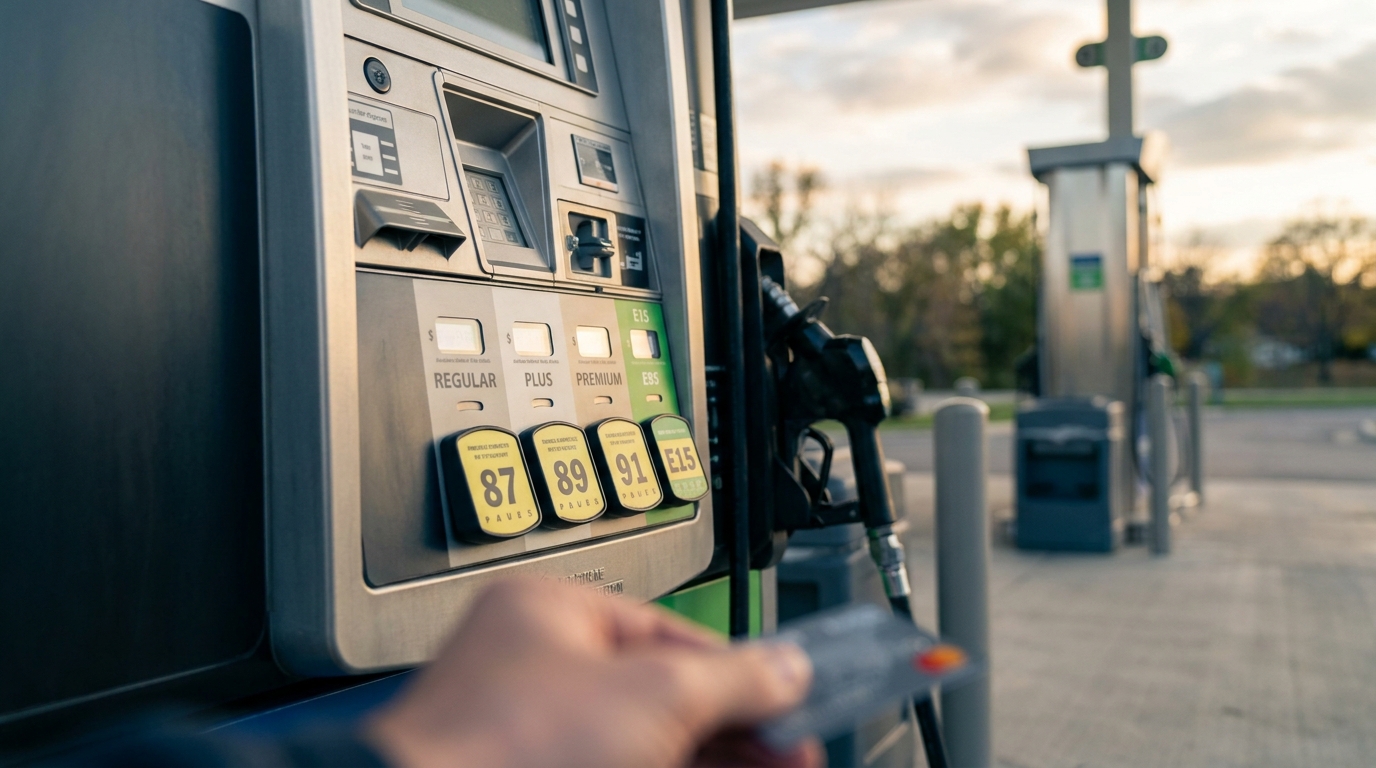
Walk into almost any US gas station and you will find at least one ethanol blend at the pump, yet most drivers have only a rough sense of what the 'E' number means. The percentage matters because ethanol and gasoline behave differently in an engine, and the blend you choose can affect your fuel economy, your wallet, and in some cases your warranty coverage. Here is a clear-eyed look at each blend.
What the 'E' Number Actually Measures
The number after the letter E is simply the percentage of ethanol by volume in the fuel. E10 is 10% ethanol and 90% gasoline. E15 is 15% ethanol and 85% gasoline. E85 sits at the high end, containing between 51% and 83% ethanol depending on the season and region, because refiners adjust the blend to meet cold-weather starting requirements. The US Department of Energy maintains a detailed breakdown of these blending specifications on its Alternative Fuels Data Center.
Ethanol is an alcohol produced primarily from corn in the United States, with the country's renewable fuel program governed by the Renewable Fuel Standard administered by the EPA. From an energy standpoint, ethanol contains roughly one-third less energy per gallon than pure gasoline. That gap is the central reason ethanol content directly influences the miles you travel on each gallon.
E10: The Baseline Blend Most Drivers Already Use
E10 is by far the most common fuel sold in the United States. The EIA estimates that the vast majority of retail gasoline sold domestically is blended to the E10 level, so if you have been buying regular unleaded without thinking about it, you have almost certainly been burning E10 for years. Federal regulations allow E10 in all gasoline-powered vehicles, and every major automaker approves its use.
The fuel economy penalty relative to pure gasoline is real but modest. Because ethanol has lower energy density, you can expect roughly a 3–4% reduction in miles per gallon compared with ethanol-free fuel. For a vehicle rated at 30 mpg on ethanol-free gas, that translates to about one mile per gallon in real-world terms. Most drivers will not notice the difference trip to trip, but it does show up in careful long-term tracking.
One practical note: if you fill up at a marina or small airport, you may encounter ethanol-free fuel labeled E0. Boat engines and small aircraft engines are often certified only for E0, and some classic car owners seek it out as well. Availability is limited and prices are typically higher, but fueleconomy.gov maintains a locator tool for ethanol-free stations.
E15: A Slightly Higher Blend With Compatibility Limits
E15 adds five more percentage points of ethanol and is approved by the EPA for use in model year 2001 and newer light-duty vehicles, but that approval does not extend to all engines. Motorcycles, heavy-duty vehicles, boats, and small off-road engines are not approved for E15, and using it in those applications can void warranties and potentially cause damage. The pump will carry a required label stating those restrictions.
The fuel economy difference between E10 and E15 is small, generally in the 1–2% range for most drivers. Because E15 is sometimes priced a few cents below E10, the math on cost per mile can be close to neutral or marginally in your favor, depending on local pricing. It is worth checking your owner's manual before switching, since some automakers have specific guidance even for covered model years.
E85: High Ethanol for Flex-Fuel Vehicles Only
E85 is a fundamentally different product that requires a flex-fuel vehicle, commonly designated FFV by manufacturers. FFVs are equipped with fuel system components, sensors, and engine management software capable of handling the corrosive and solvent properties of high ethanol concentrations. Running E85 in a standard vehicle is not a gray area: it can damage fuel lines, injectors, and seals, and it will not be covered by warranty.
The fuel economy penalty with E85 is significant and worth calculating before assuming you are saving money. Because of ethanol's lower energy density, most FFVs see a 25–30% drop in mpg when running E85 compared with E10. A truck rated at 20 mpg on E10 might return 14–15 mpg on E85. Whether the per-gallon price difference at the pump offsets that gap depends entirely on local pricing, which varies considerably by region according to EIA data.
If you own an FFV and have access to competitively priced E85, the US Department of Energy's eGallon tool and the fuel cost calculator at fueleconomy.gov are useful resources for running the actual numbers before committing to a fill-up strategy. In states where E85 is heavily discounted, the cost per mile can be competitive. In others, it is not.
Price Differences and What Drives Them
Corn prices, refinery decisions, and regional distribution costs all influence ethanol blend pricing at the pump. E15 is often priced slightly below E10 because refiners can substitute cheaper ethanol for more expensive petroleum components. E85 pricing relative to regular gasoline swings more dramatically and tends to be most favorable in Corn Belt states close to ethanol production.
The EIA publishes weekly retail fuel price data by region and blend type, which is the most reliable source for tracking these spreads over time. A few cents difference at the pump can look attractive, but that number needs to be divided by a lower mpg figure to determine actual cost per mile. Running that calculation once takes about two minutes and gives you a much clearer picture than the sticker price alone.
Checking Compatibility Before You Fill Up
Your owner's manual is the authoritative source for what your specific vehicle supports. Beyond that, the EPA maintains an online certification database, and fueleconomy.gov provides vehicle-specific guidance. FFV status is usually noted on the inside of the fuel door or in the vehicle trim description. If you are unsure, defaulting to E10 is always the safe choice for any modern gasoline vehicle.
For older vehicles, particularly those made before 1994, ethanol content deserves closer attention. Rubber components and certain metals used in older fuel systems can degrade more quickly with higher ethanol concentrations. Consulting a mechanic familiar with older vehicles is a reasonable step if you are uncertain.
The takeaway
E10 is safe for virtually every modern gasoline vehicle and carries only a small mpg penalty. E15 works in most post-2001 cars but check your manual first. E85 is for flex-fuel vehicles only, and whether it saves money depends on local prices divided by a meaningfully lower mpg figure. Run the math before you choose.