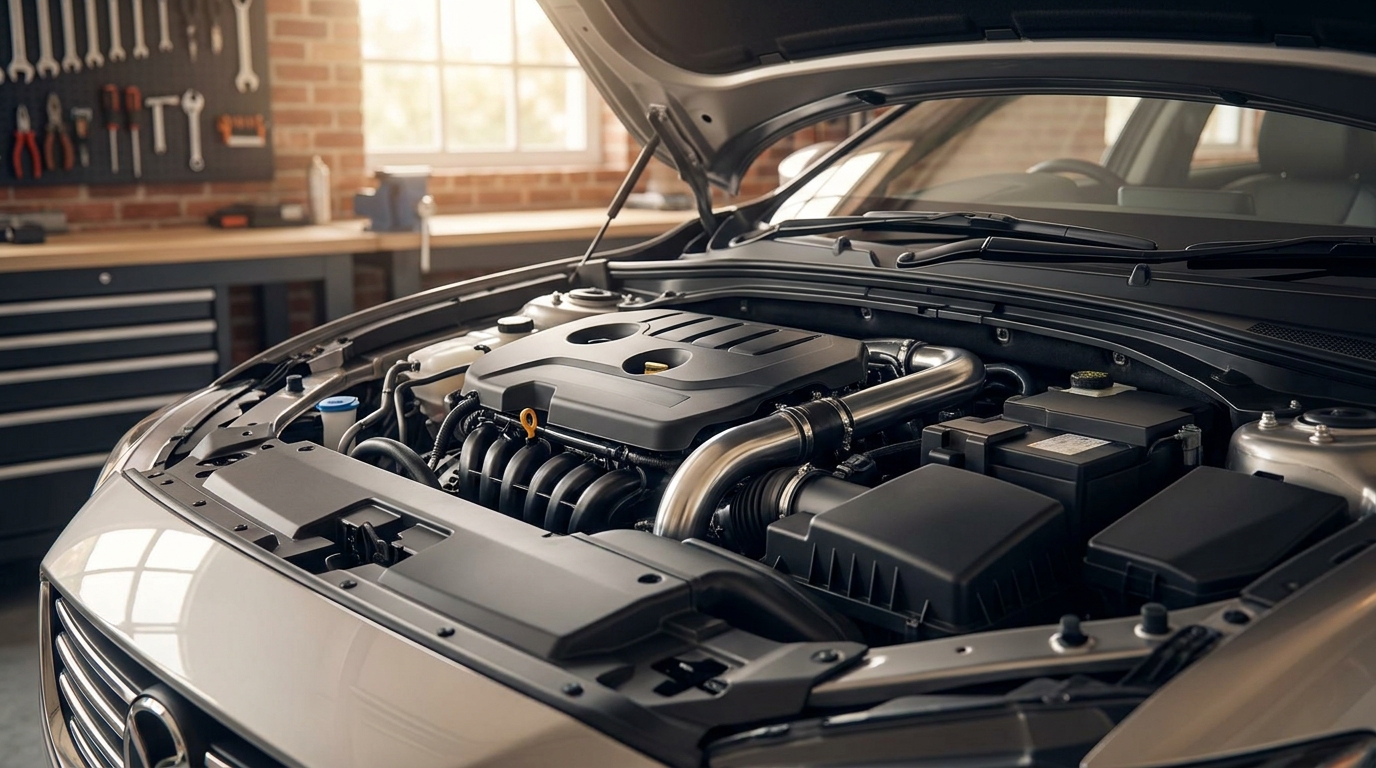
Walk through any new car lot and pop the hoods. You will find 1.5-liter turbos in midsize SUVs, 1.0-liter three-cylinders in compact cars, and 2.0-liter turbos doing work that V6 engines handled a decade ago. This is engine downsizing, and it is now the dominant approach across nearly every mainstream automaker. The reasoning is sound on paper. The real-world results are more complicated.
How We Got Here: CAFE Rules and the EPA Test Cycle
Corporate Average Fuel Economy standards have ratcheted upward since 2012, pushing automaker fleet averages well above 30 mpg combined on the EPA test. Building larger naturally aspirated engines that meet these targets is difficult, so manufacturers turned to a different formula. Shrink the displacement, add a turbocharger, and use direct injection to keep power competitive.
The EPA city and highway cycles are run at modest loads with gentle acceleration. Under those conditions a small turbo engine spends most of its time off-boost, behaving like an efficient small engine. That is exactly when downsized powertrains shine, and it is why window sticker numbers improved steadily through the 2010s.
The trouble is that few drivers replicate the EPA cycle. Merging onto highways, climbing grades, and hauling passengers all push these engines into boost, where the efficiency advantage shrinks or disappears entirely.
The Real-World MPG Gap
Fueleconomy.gov publishes user-reported mileage alongside official EPA estimates, and a pattern has emerged. Small turbocharged engines tend to show wider gaps between sticker and reality than larger naturally aspirated or hybrid powertrains. Owners of 1.5T and 2.0T crossovers frequently report 2 to 5 mpg below the combined EPA figure, particularly in mixed suburban driving.
Part of this is physics. A 1.5-liter engine moving a 4,000-pound SUV must run in boost more often than a 2.5-liter would. Boost means more fuel, richer mixtures under sustained load, and the loss of the pumping efficiency that made the small engine attractive in the first place.
Driving style amplifies the gap. A heavy right foot on a turbo four can drop fuel economy by 15 to 20 percent compared to a patient driver. The same input on a larger naturally aspirated engine produces a smaller penalty because the engine was not relying on forced induction to deliver acceptable power.
Reliability and Maintenance Tradeoffs
Turbocharged direct-injection engines run at higher cylinder pressures and temperatures than the engines they replaced. That has consequences. Carbon buildup on intake valves, once rare, is now a known service item on many GDI engines because fuel no longer washes the valves. Some owners face walnut-blast cleaning every 60,000 to 80,000 miles.
Oil quality matters more than it used to. Low-speed pre-ignition, timing chain stretch, and turbo bearing wear all track with oil condition. Following the severe-service interval, typically 5,000 miles, is sensible insurance on these engines even when the manual allows longer.
None of this makes modern turbo engines unreliable in absolute terms. It does mean the total cost of ownership math is less favorable than the fuel savings alone suggest, especially past 100,000 miles.
When Downsizing Actually Pays Off
For drivers who genuinely match the EPA cycle, mostly steady highway cruising at legal speeds, light city traffic, and no towing, a small turbo can deliver close to its sticker number. Commuters with flat routes and patient habits often report meeting or beating EPA combined figures.
Premium fuel requirements are worth checking. Many 2.0T and 1.5T engines are tuned for 87 octane but make peak output on premium. The cost difference at the pump often erases the fuel economy advantage versus a comparable naturally aspirated vehicle running regular.
What to Look For When Shopping
Compare the EPA combined number to user-reported averages on fueleconomy.gov before committing to a downsized model. A gap larger than 3 mpg suggests the engine struggles outside the test cycle. Also weigh the hybrid alternative in the same showroom. A conventional hybrid typically delivers its rated mpg more consistently because regenerative braking and electric assist reduce reliance on the engine during the exact conditions where turbos lose efficiency.
Tow ratings deserve a hard look. A 1.5-liter turbo rated to tow 3,500 pounds will do it, but fuel economy under load can drop into single digits, and the long-term wear cost is real.
The takeaway
Downsized turbo engines are not a trick, but they are optimized for a test that few drivers replicate. If your driving leans toward steady highway cruising, a small turbo can deliver. If it leans toward stop-and-go, hills, or hauling, a larger naturally aspirated engine or a hybrid will likely match its sticker more honestly. Check user-reported mpg before you sign.