Home charging is one of the main reasons EV ownership pencils out, but the cost to set it up varies wildly. Some drivers spend $300, others spend $3,000, and a meaningful share spend nothing at all because a standard wall outlet covers their needs. The right answer depends on your daily mileage, your panel, and how patient you are. Here is what the numbers actually look like.
Level 1 vs Level 2: What You Actually Get
Level 1 charging uses the 120-volt outlet already in your garage or driveway. According to the US Department of Energy, it adds roughly 3 to 5 miles of range per hour. Plug in at 7 p.m. and unplug at 7 a.m., and you have replenished somewhere between 35 and 60 miles. For the average US driver, who covers about 35 to 40 miles per day per Federal Highway Administration data, that is enough.
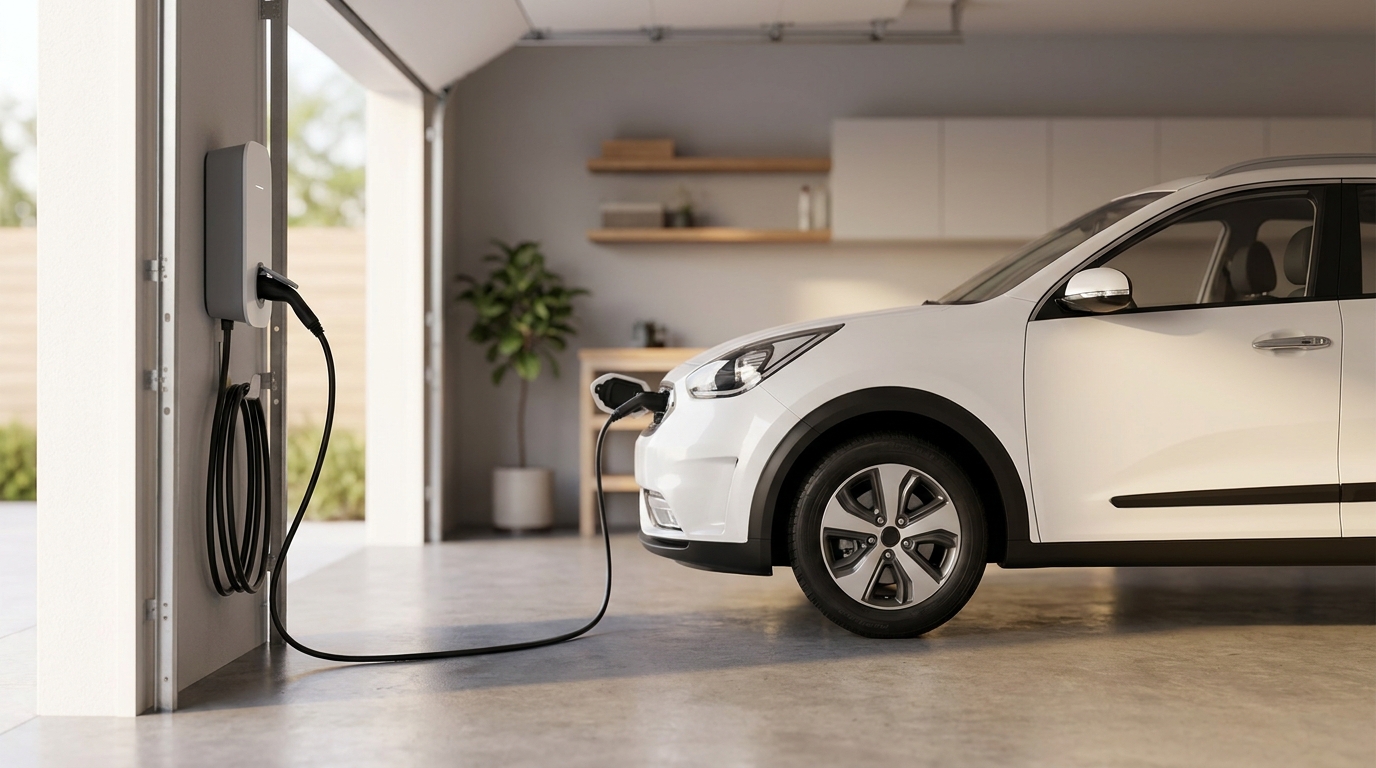
Level 2 runs on 240 volts, the same circuit class as an electric dryer. Real-world delivery is typically 20 to 30 miles of range per hour, depending on the charger amperage and the car's onboard charger. A depleted battery can refill overnight rather than over two or three nights. The convenience is real, but it is not always necessary.
The True Cost of a Level 2 Install
The charger itself, often called EVSE, runs $400 to $800 for a reputable 40-amp or 48-amp unit. That is the easy part. Installation labor and materials are where the bill swings. A clean install, where the electrical panel sits in the garage and has spare capacity, can run $300 to $600 in labor.
Long conduit runs, trenching to a detached garage, or a panel upgrade change the math quickly. A 200-amp service upgrade alone typically runs $1,500 to $4,000 depending on the utility and permit fees. Add that to the charger and basic wiring, and the all-in cost can climb past $3,500. National survey data from EV owner groups generally pegs the median total install at $1,000 to $2,000.
| Scenario | Hardware | Install labor | All-in total |
|---|---|---|---|
| Panel in garage, spare capacity | $400–$800 | $300–$600 | $700–$1,400 |
| Short conduit run, no upgrade | $400–$800 | $600–$1,200 | $1,000–$2,000 |
| Detached garage or trenching | $400–$800 | $1,200–$2,500 | $1,600–$3,300 |
| Requires 200-amp panel upgrade | $400–$800 | $2,500–$4,500 | $2,900–$5,300 |
When a Standard Outlet Is Genuinely Enough
If you drive under 40 miles a day and park at home for 10 or more hours overnight, Level 1 is often sufficient. Plug-in hybrids in particular almost never need Level 2, because their batteries are small enough to refill on 120 volts in 4 to 8 hours.
The fueleconomy.gov calculator makes this easy to verify. Take your daily miles, divide by 4 (a conservative Level 1 rate), and that is how many hours of charging you need each night. If the number is below 12, you probably do not need to spend a cent on hardware. A heavy-gauge extension cord is not recommended, but a dedicated 15-amp or 20-amp outlet works fine.
Incentives Can Cut the Bill Substantially
The federal Alternative Fuel Vehicle Refueling Property Credit covers 30 percent of hardware and installation costs, up to $1,000 for residential installs in eligible census tracts. Many state utilities layer their own rebates on top, ranging from $200 to $1,500. Check the DOE's Alternative Fuels Data Center for current programs in your zip code.
Time-of-use electricity rates are a separate but related savings lever. Charging between midnight and 6 a.m. on a TOU plan can cut your per-kWh cost by 30 to 50 percent versus the standard rate. Over a year of typical EV driving, that gap is often worth more than the install itself.
A Practical Decision Framework
Start with your daily mileage and your panel. If you drive less than 40 miles a day and have any 120-volt outlet near where you park, try Level 1 for a month before spending anything. Most drivers find it works.
If your commute is longer, you own two EVs, or you have a battery above 80 kWh, Level 2 starts to pay for itself in time saved and flexibility. Get at least two quotes from licensed electricians, ask whether your panel needs an upgrade before they arrive, and confirm the permit cost up front. Surprises on this line item are common.
The takeaway
Before you spend on a Level 2 charger, test whether a 120-volt outlet covers your daily driving. Many households find it does. If you do need Level 2, get multiple quotes, ask about panel capacity early, and claim every federal and utility incentive you qualify for. The right setup is the cheapest one that fits your actual commute.