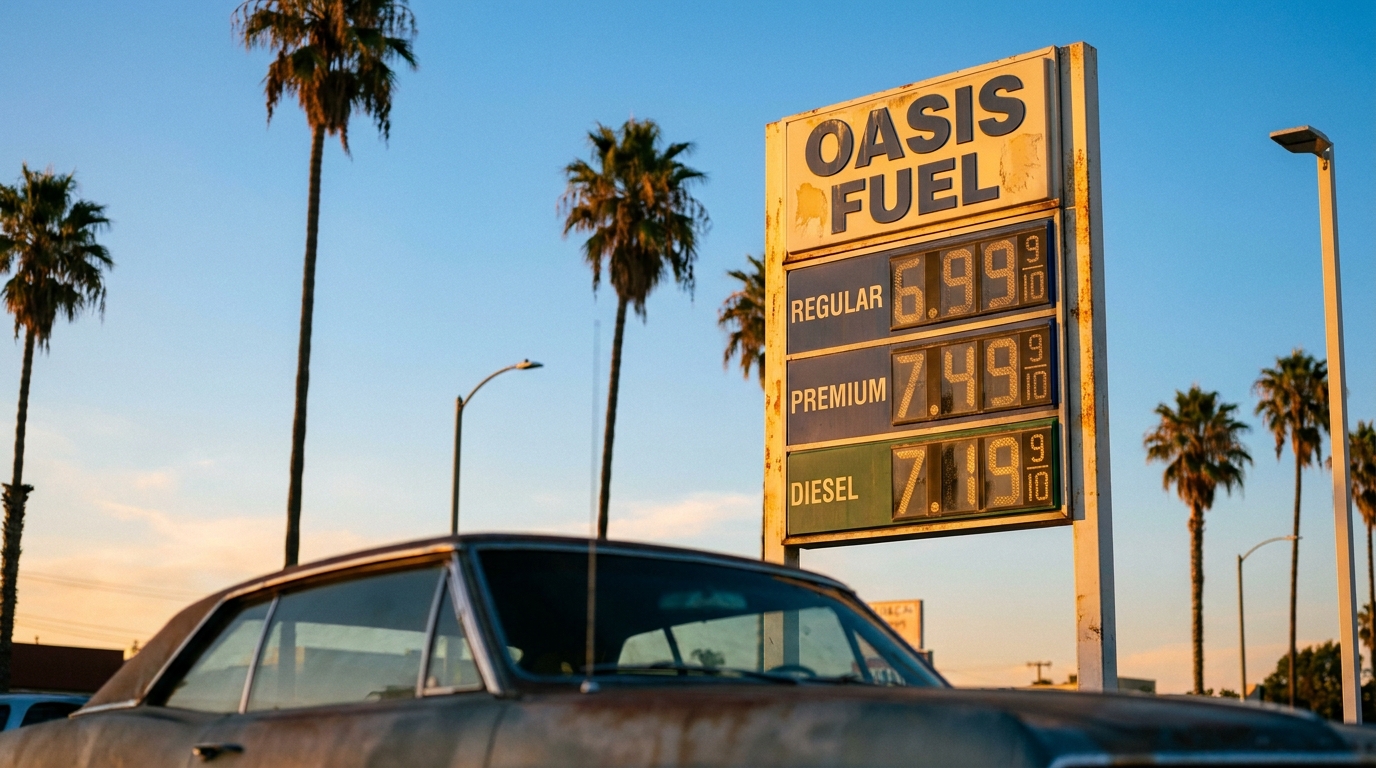
If you've ever noticed gas prices climb steadily through March and April, then drop through September and October, the pattern isn't just demand. Twice a year, the federal government requires the gasoline in your tank to change recipe — and the switch is expensive for refiners and distributors.
What actually changes
Summer gasoline (roughly May 1 through September 15, with some regional variation) has a lower Reid Vapor Pressure (RVP) — it's harder to evaporate. This reduces smog-forming emissions during hot weather, when vapors escape easily from fuel tanks and evaporative emissions from gas stations spike.
Winter gasoline has a higher RVP, because in cold weather you need a more volatile fuel just to start and run the engine reliably. It's also cheaper to produce — butane, a very cheap component that can be blended into winter gas, has to be stripped out of summer gas because it flashes off too easily.
Why the switchover costs money
The transition isn't gradual. Refineries and terminals have to fully purge their systems of the outgoing blend before the new one can be legally pumped. Tank bottoms get drained or diverted to off-spec markets. Pipelines have to run a "transmix" of intermediate product that has to be re-processed.
This planned downtime and product turnover historically adds $0.15 to $0.35 per gallon to retail prices through March and April. The reverse switch in September is smaller ($0.05 to $0.15) because going from summer to winter blend is a less expensive transition — you're adding cheap butane back in, not removing it.
| Property | Winter (Sep 16 – May 1) | Summer (May 1 – Sep 15) |
|---|---|---|
| Reid Vapor Pressure | 13.5–15.0 psi | 7.0–9.0 psi |
| Butane content | Up to 10% | Near 0% |
| Energy content | ~110,000 BTU/gal | ~115,000 BTU/gal |
| MPG impact | ~1–2% lower | ~1–2% higher |
| Production cost | Cheaper | +$0.15–$0.30/gal |
| Smog (VOC) emissions | Higher | Lower |
Reformulated vs. conventional: not the same thing
About a third of the US market (mostly urban areas and the Northeast) uses Reformulated Gasoline (RFG) year-round, which has additional anti-emissions requirements beyond the seasonal RVP change. Most of the rest uses conventional gasoline.
RFG markets (New York, Los Angeles, Chicago, Houston) see larger price premiums year-round because the underlying fuel is more expensive to produce. California's CARB blend is even more specialized, which is a big part of why its gap to the national average is so persistent.
Regional quirks to know
The Midwest summer switchover is especially notable because many Midwest states use a corn-ethanol-blended summer RFG, which adds another moving part (ethanol pricing and RIN credits) to the seasonal math. A refinery outage in the Midwest in April-May can push prices up sharply — this is why Chicago and Detroit see some of the biggest springtime price spikes in the country.
The Rocky Mountain states are the exception: much of the region is exempt from RFG requirements and uses high-RVP gasoline year-round because the elevation and cool climate don't produce the same summer smog conditions. This is part of why gas in Colorado and Wyoming can be noticeably cheaper than the national average in April and May.
Can you time your fill-ups around this?
Mostly, yes — if you have flexibility. Gas is consistently cheapest in October through January, not because demand drops (it doesn't fall as much as you'd think), but because winter-blend is genuinely cheaper to make. March through May is the expensive season, with Memorial Day typically landing near a local peak.
Topping off a tank in late September instead of mid-April will save real money. The downside is that the difference, while consistent, is usually $0.15 to $0.40 per gallon — worth knowing, not worth driving across town for.
The takeaway
The blend change is the quietest, most predictable driver of gas-price seasonality. It's not a market conspiracy and it's not refinery greed — it's federal emissions regulations colliding with the cost of summer-spec fuel. Knowing this at least lets you stop being surprised every April.