A car that's overdue for maintenance burns measurably more fuel than one that's caught up — but most of the culprits don't set off warning lights until they're far gone. These five items, in the order they most commonly go unnoticed, are the ones quietly costing you money at every fill-up.
1. Engine air filter (5 to 10% MPG)
The engine needs clean air in the same ratio it needs fuel — roughly 14 parts air to 1 part gasoline. A clogged filter throttles the engine's breathing and forces the management computer to compensate by enriching the mixture, burning more fuel for the same power.
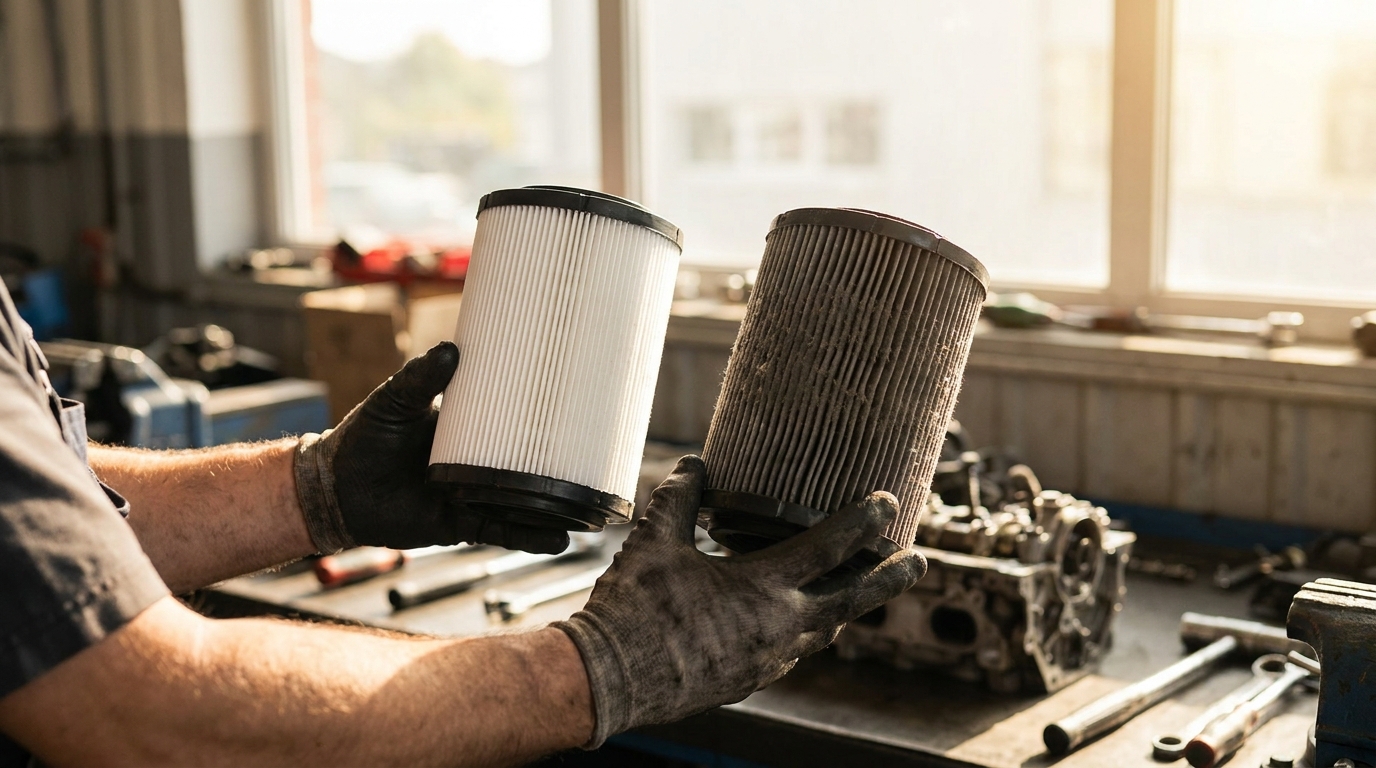
A good air filter lasts 15,000 to 30,000 miles in normal driving, less in dusty or rural conditions. They cost $15 to $30 and take under five minutes to swap. Check visually every oil change — if it's visibly grey and the folds are packed with debris, replace it.
2. Spark plugs (3 to 8% MPG)
Worn or fouled plugs cause incomplete combustion — a small fraction of your fuel leaves the cylinder unburnt, contributing nothing to forward motion. Modern iridium plugs are rated for 80,000 to 100,000 miles, but they don't suddenly fail; they degrade gradually, and the MPG hit builds up for 20,000 miles before anyone notices.
Replacement is about $80 to $200 at a shop (much of it labor), or $40 in parts for DIY on most four-cylinder engines. The fuel savings over a year of normal driving typically pays the job back.
3. Oxygen (O2) sensor (up to 15% MPG)
The O2 sensor in your exhaust tells the engine how much oxygen is left after combustion — directly informing how much fuel to inject. A lazy or failing sensor is one of the most expensive silent problems in modern cars, because it can cause the computer to run 15% rich for months without tripping a check-engine code.
Signs: rough idle, sometimes a faint fuel smell, unexplained drop in MPG against your own historical average. On cars over 100,000 miles with no record of replacement, it's worth asking about.
4. Brake calipers (2 to 7% MPG)
A sticking or seized brake caliper drags the pad against the rotor continuously, even when your foot is off the brake. This converts fuel directly into heat and brake dust — sometimes enough to noticeably overheat the wheel.
The symptom is a wheel that's much hotter than the others after a drive, uneven tire wear, or pulling to one side. Dragging calipers often aren't discovered until someone measures pad thickness and finds one side is gone while the other is fine.
5. Fuel injectors (2 to 5% MPG)
Over 80,000 to 100,000 miles, injectors develop carbon deposits on the nozzles that disrupt spray patterns. Instead of a clean mist, the fuel partially streams — combustion becomes less efficient, and MPG drops 2 to 5% gradually.
The cheap fix is a bottle of top-tier injector cleaner (something with polyetheramine, like Techron, Red Line SI-1, or Gumout Regane) every 10,000 miles. Running one of these through a full tank is roughly $10 and consistently shows measurable cleaning in independent tests. Professional fuel-system service is the nuclear option for neglected cars.
| Issue | MPG hit | DIY cost | Shop cost | Annual fuel cost* |
|---|---|---|---|---|
| O₂ sensor failing | up to −15% | $40–80 | $200–400 | $240/yr |
| Clogged air filter | −5 to −10% | $15–30 | $50–80 | $120/yr |
| Worn spark plugs | −3 to −8% | $40 | $80–200 | $90/yr |
| Sticking brake caliper | −2 to −7% | $60–150 | $200–500 | $70/yr |
| Dirty fuel injectors | −2 to −5% | $10 (cleaner) | $150–300 | $55/yr |
The takeaway
None of these will fail dramatically — they just degrade. Stack all five and a car that's 100,000 miles overdue on air filter, plugs, and injector service can easily be running 15 to 20% worse than it did new. Basic maintenance isn't glamorous, but it's almost always cheaper than the fuel it saves.