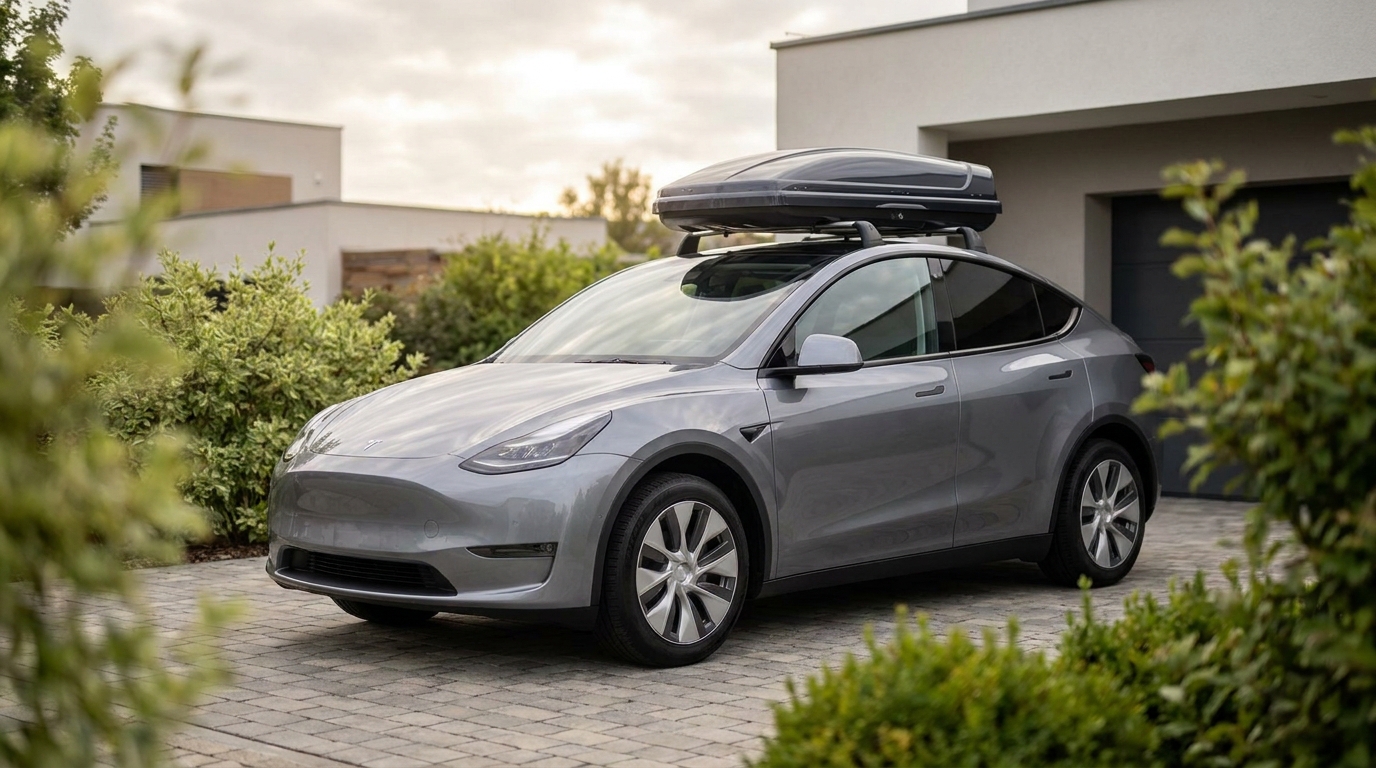
The US Department of Energy measured it directly: a large, loaded rooftop cargo box cuts highway fuel economy by 10 to 25% on an average car. Even a pair of empty aluminum crossbars — the kind most crossovers ship with — costs 1 to 3% year-round. Most drivers pay this tax for months after they need to.
Why rooftop cargo hits so hard
Cars are designed to cut cleanly through air. The shape you see in a wind tunnel is the result of millions of dollars of engineering to reduce drag coefficient by a few hundredths. A cargo box bolted to the roof throws all of that out and adds a brick-shaped obstacle directly in the airstream.
The penalty scales with speed, because aerodynamic drag rises with the square of speed. At 35 mph city driving a cargo box is barely noticeable. At 75 mph highway cruise it's the difference between a 28-MPG sedan and a 21-MPG sedan.
Even empty crossbars cost you
Most crossovers and SUVs leave the factory with "flush rails" on the roof. Adding crossbars to those rails — even without anything on them — adds about 1 to 3% highway fuel economy penalty, because the bars themselves disrupt airflow.
If you only use the roof rack twice a year for a bike trip and a ski trip, leaving the crossbars on costs more than the fuel for those trips. Most modern rack systems are designed to come off in under five minutes with a hand tool.
Cargo box vs. hitch rack vs. trunk
All rooftop carriers are worse than nothing, but not all are equal. An aerodynamic cargo box (shaped like a long teardrop) costs less drag than a bare roof basket by about half. A bike rack clamped to the top can be the worst of all — bikes on the roof are pure drag with no aerodynamic benefit.
Hitch-mounted racks and trunk-mounted bike racks have a fraction of the fuel penalty because they sit in the low-pressure zone behind the car rather than in the high-pressure airstream above it. If you have a choice, hitch-rear beats roof-top nearly every time.
Storage weight vs. storage drag
One lingering myth: "the weight is what hurts MPG." Not really, on flat ground. Moving 100 pounds of cargo costs about 1% fuel economy — noticeable but small. What kills you is the aerodynamic disruption.
This is why an empty roof box still costs you 10% on the highway: it's the shape, not the weight. And it's why a full trunk doesn't cost meaningfully more fuel than an empty one, as long as the load is inside the vehicle's silhouette.
The five-minute rule
If you're not actively using the rack or box this week, take it off. Most modern cargo boxes dismount in two or three minutes with a quick-release system. Crossbars come off in about five.
For drivers who use the rack only during one or two seasons, this single habit — off in spring, back on in winter — is worth $50 to $200 a year at 2026 gas prices. Not life-changing, but more than most tune-up advice delivers.
The takeaway
Roof real estate is tempting but expensive. Use it when you need it; take it off when you don't. The box that lives on your car year-round "just in case" is quietly costing you one or two full tanks a year for a couple of weekend trips it wasn't even used for.